Dr. Hamid Shahanaghi
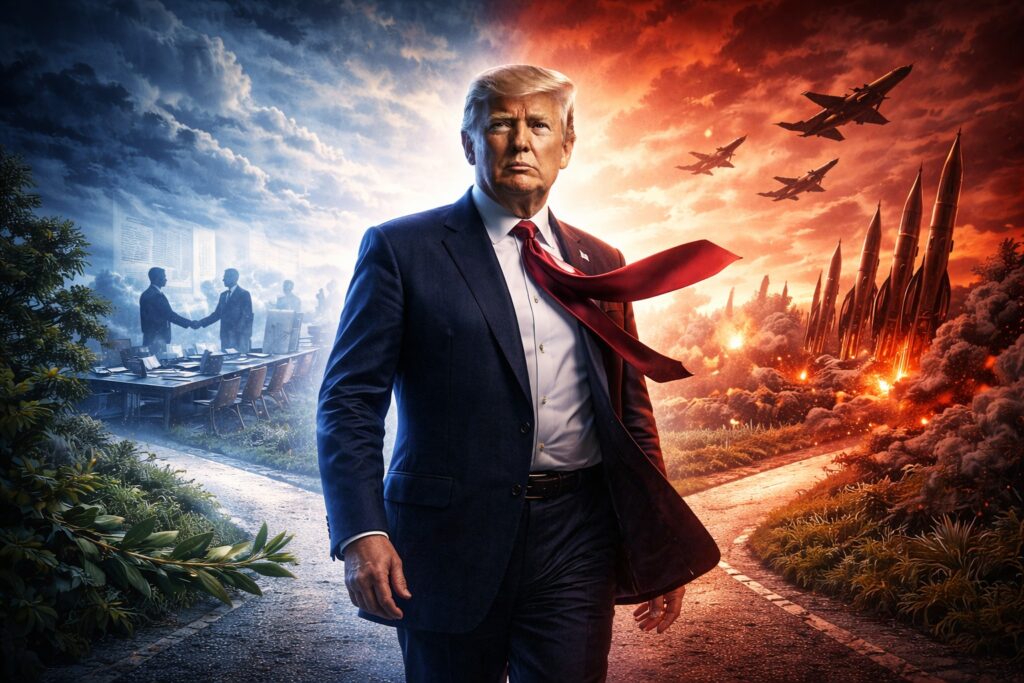
Analyzing Donald Trump’s behavioral patterns and discourse towards the Islamic Republic of Iran requires a deep exploration of the underlying layers of his personality and its connection to his lessons learned in the business world, in order to answer whether his actions are the product of conscious strategic planning or merely stemming from psychological impulses. The reality is that in Trump’s intellectual framework, the distinction between personality and strategy has practically disappeared; in other words, he employs his inherent characteristics as a tool to advance political goals. This approach, known in political literature as the “madman theory,” rests on the assumption that if a leader can convince his enemies that he is unpredictable, reckless, and even willing to take extreme actions, the opposing side will concede more advantages for fear of uncontrollable consequences. By leveraging this theory, Trump creates a strategic ambiguity around his decisions, keeping both enemies and even allies in a state of perpetual uncertainty. However, psychological analysts believe this behavior is not merely a strategic mask but is rooted in “Narcissistic Personality Disorder” (NPD), characterized by an excessive need for admiration, extreme sensitivity to criticism, and a tendency to divide the world into absolute poles of friend and enemy. These personality traits have led him to define Iran within a stereotypical and simplistic framework as the “bad actor” and “absolute threat,” an approach that sacrifices geopolitical complexities for simple, black-and-white answers.
The Psychology of the “Madman” and Business Roots: Transforming Individual Traits into a Tool of Pressure
The roots of this behavior must be sought in his business background and the principles outlined in his book “The Art of the Deal.” Trump learned in the New York real estate market that negotiation is a zero-sum game where identifying and attacking the opponent’s weaknesses is key to success. He applies the same business techniques in international diplomacy: anchoring in maximalist positions, threatening to walk away from the negotiating table to demonstrate independence from the deal, and using bluff and exaggeration to intimidate the rival. He sees himself as a “master observer” who, by carefully studying the opponent’s psychology, calibrates his levers of pressure to leave the other side with the least room for maneuver. In fact, his doctrine towards Iran is a combination of economic “maximum pressure” and behavioral “maximum ambiguity,” rooted in his aversion to traditional bureaucracies and his inclination towards centralized, individual-centric leadership. Instead of relying on institutional analysis, he focuses on personal instinct and his brand image, which sometimes puts his decisions at odds with senior advisors. For instance, regarding the plan to attack Iran at the end of his first presidential term, he claimed to have avoided war despite the insistence of generals like Mark Milley.
Examining Trump’s first presidential term, the unilateral withdrawal from the nuclear agreement (JCPOA) in 2018 was a turning point in his strategy. He called the deal “terrible and one-sided,” claiming it only enriched the Iranian regime and expanded its regional influence. His goal in re-imposing heavy sanctions was to paralyze Iran’s economy and force Tehran to the negotiating table to reach a more comprehensive agreement that would encompass not only the nuclear program but also Iran’s missile capabilities and regional influence. By using secondary sanctions, Trump also put European allies in a bind, forcing them to choose between the American market and trade with Iran – an action that created an unprecedented rift in transatlantic relations and was described by European analysts as irresponsible and colonialist behavior. Despite widespread international criticism that Iran was complying with its commitments, Trump, based on the same business logic of “upending the game to gain more advantage,” withdrew from the deal to show he was not afraid of walking away from bad deals. While this policy in his first term dealt severe blows to Iran’s economy and drastically devalued the Rial, it did not achieve its ultimate goal of collapsing the regime or fundamentally changing its behavior.
The “Peace Through Strength” Doctrine: Transition from Economic Pressure to Midnight Hammer Operations
Trump’s second presidential term, beginning in 2025, witnessed a shift from economic pressure to a much more aggressive combined “military-diplomatic” strategy. In this period, Trump no longer confined himself to sanctions and, with the execution of “Operation Midnight Hammer” on June 22, 2025, directly targeted Iran’s nuclear infrastructure. This attack, involving over 125 aircraft and the use of 30,000-pound GBU-57 bunker-buster bombs, severely damaged the Fordow, Natanz, and Isfahan facilities. Trump used this action as proof that his “word matches his deed,” warning Iranian officials that failure to accept a new deal would result in far more “traumatic” consequences. This evolution signals a shift in his doctrine towards “imposing peace through force,” where military power acts as the primary complement to the negotiating table. By constantly reminding of the destructive power of these attacks on social media, he tries to keep Tehran in a state of perpetual fear and convince them that continuing on their current path puts the regime’s physical survival at risk.
By February 2026, the “negotiate or war” path has reached a fateful moment. On one hand, Trump is sending signals of readiness for a “grand deal” by dispatching letters to Iran’s leadership and sending negotiating teams to Oman and Turkey. Even in his meetings with Benjamin Netanyahu at Mar-a-Lago, he has emphasized his preference for reaching a diplomatic deal, claiming that Iran is “very willing to make a deal.” On the other hand, by deploying a second aircraft carrier (the Gerald R. Ford) to the region and increasing the military presence in the Persian Gulf, he has shown no hesitation in starting a “war of the century” should negotiations fail. This behavioral paradox is a product of his business perspective, where threatening the complete destruction of the opponent is a tool to secure the most favorable terms in a deal. Meanwhile, Iran faces deep internal crises; from the Rial’s collapse to 1.4 million against the dollar, to widespread protests that began in December 2025 and have been met with severe crackdowns. Understanding these structural weaknesses, Trump focuses his pressure on points that could lead to the collapse of the regime’s internal legitimacy, even promising that the United States would come to the aid of Iranian protesters.
Collapse of Strategic Depth and Regional Isolation: The Final Impasse on the Path to Negotiation or War
Regional geopolitical changes in 2026 have also severely weakened Iran’s position. The fall of Bashar al-Assad’s regime in Syria in December 2024, a key pillar of the “Axis of Resistance” and a vital link between Iran and Hezbollah, dealt a strategic blow to Tehran’s strategic depth. This defeat caused Iran’s “forward defense” doctrine to collapse, forcing Tehran to retreat from many of its regional ambitions to ensure its internal security. Trump, capitalizing on this regional isolation, has presented Iran with a binary choice: either accept Washington’s threefold conditions (complete cessation of enrichment, missile restrictions, and ending support for proxy groups) or face military strikes that could lead to the regime’s overthrow. While Iranian President Masoud Pezeshkian attempts to find a diplomatic way out of sanctions, hardliners in Tehran continue to emphasize resistance; however, the fear of a war that could end the regime has even prompted Iran’s Supreme Leader to reconsider negotiation options.
In conclusion, it can be argued that Trump’s behavior and discourse are the outcome of a “strategic personality” where unpredictability is his primary weapon. Using a combination of business bluffs, precise military strikes, and personal letters, he seeks to steer Iran towards his desired outcome: a deal he can sell to the world as the ultimate victory for his brand. For Trump, Iran is not a complex national security issue but a “deal subject” to be resolved with maximum pressure and minimum cost. The effect of these traits on the future path is the creation of an atmosphere that is “highly dangerous yet ripe for a deal.” If Iran can find a way to satisfy Trump’s need for dramatic victories, war might be avoided; however, given his risk-taking spirit and insistence on Iran’s complete disarmament, the probability of a large-scale military confrontation remains a real option on the table. Indeed, in February 2026, he declared that if no deal is reached, “we are ready and the safety catches are off.” This approach transforms international diplomacy into an arena of high-stakes gambling, where the line between peace and destruction depends solely on one of Donald Trump’s individual decisions.
A deeper analysis of Trump’s psychological layers reveals that he holds a “negative schema” towards Iran, evaluating any interaction from a distorted and pessimistic angle. This causes him to maintain an aggressive tone even during negotiations, lest he appear weak. In his view, “strength” is the only language America’s rivals understand, and therefore, any diplomatic flexibility must be accompanied by a display of military power. This is precisely why, during the Oman talks in February 2026, he ordered the repositioning of aircraft carriers while his envoys were simultaneously seated at the table. With this action, he sent Tehran the message that negotiation is conducted not from a position of need, but from one of absolute superiority. In response, Iran’s strategy, based on “delay and deceit” tactics to buy time, directly clashes with Trump’s inherent impatience and, instead of resolving diplomatic knots, could provoke him into sudden military action.
The impact of these traits on America’s regional allies is also evident. Israel and some Gulf states, understanding Trump’s “deal-maker” mentality, try to flatter him and highlight his leadership role to steer him towards adopting tougher stances against Iran. Netanyahu has learned well how to use Trump’s preferred rhetoric to turn him into his “stick” against Iran’s nuclear and missile programs. In this atmosphere, the room for maneuver for the traditional diplomacy sought by Europeans has shrunk to nearly zero; Trump has proven he feels no obligation to his predecessor’s international commitments and prefers to rewrite the rules of the game based on his momentary interests and personal image, rather than following global norms. Consequently, Iran’s path in 2026 is being determined not in the corridors of the United Nations, but in Truth Social posts and secret negotiation rooms where Trump plays the lead role as a “strategic madman.” This situation has pushed Iran to the edge of a precipice where both options – “negotiation under humiliation” or “devastating war” – threaten the existence of the current political structures. This is precisely the “strategic impasse” Trump, relying on his personality traits, sought to create.
A closer examination of the military operation conducted in the second term shows that Trump used military technologies not only for physical destruction but also as a tool for the “psychological paralysis” of Iran’s leadership. The use of “bespoke fuzing” in the June 2025 attacks, where bunker-buster bombs were sequentially dropped on a single point to penetrate deep into the mountains, sent a clear message to the regime’s leaders in Tehran that no shelter was beyond the reach of Trump’s will. This type of raw power display reflects his “business bullying” spirit, where to break an opponent’s resistance, one must psychologically crush them. However, intelligence reports indicate that despite their tactical success, these attacks failed to completely break Tehran’s will; instead, they led to heightened defense measures and the relocation of facilities to less accessible locations. This reveals the core paradox of Trump’s doctrine: more pressure might lead not to submission, but to the opponent’s “strategic suicide” and the initiation of an endless regional conflict that Trump inherently detests.
Ultimately, the future of Iran-US relations in the shadow of Trump’s personality depends on whether Tehran can correctly decipher his “behavioral code.” Trump seeks grand, flashy victories that he can inscribe as his “art of the deal.” If Iran can present a version of an agreement that ostensibly cedes all victory to Trump while substantively guaranteeing the regime’s survival, a temporary peace is possible. However, if Tehran persists with its strategy of “ambiguity and resistance,” given his explosive temperament and need to maintain his “strongman” prestige, the probability of a final military confrontation in 2026 is very high – a confrontation he has previously described with the word “hammer,” ready to bring it down one last time. Therefore, Trump’s personality is not just the root of his strategy; it is the strategy itself – a strategy where the line between “madness” and “genius” will only be determined by the final outcome of the deal.