Dr. Hamid Shahanaghi
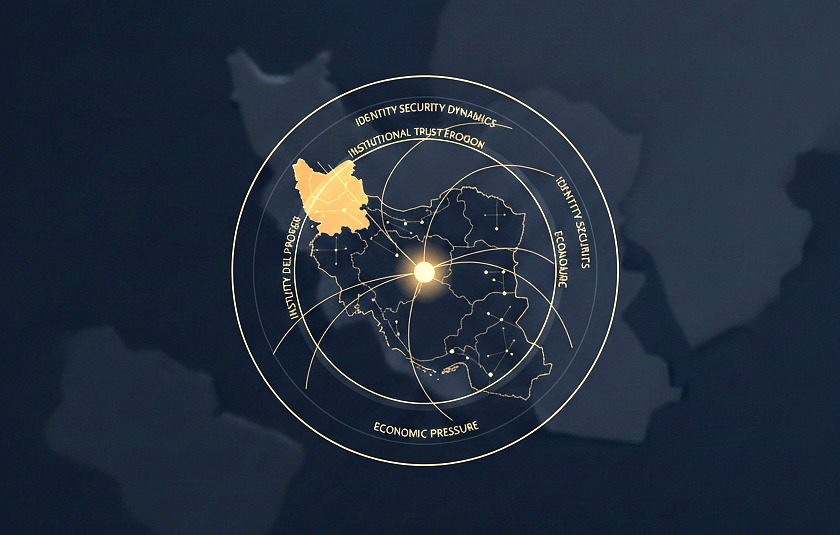
Iran’s internal developments in the mid-2020s cannot be explained solely by economic indicators or the usual cycles of political discontent. What is gradually taking shape is a complex product of economic pressure, erosion of institutional trust, and above all the accumulated fault lines in the realm of identity security. In this framework, “structural divergence” refers to the gradual distancing of development trajectories, political representation, and cultural reproduction in peripheral regions from the decision-making center in Tehran. The process has not yet reached a breaking point, but its signals are observable at multiple levels.
Identity security is considered sustainable when linguistic and ethnic groups feel that their collective identities are not only tolerated within the national framework but are also given institutional space for expression. In contemporary Iran, part of identity tension stems from perceived inequality in this very domain. The politicization of identity has in many cases been a reaction to blocked formal channels of representation rather than a pre-designed project of divergence. For this reason, any assessment of the current situation that ignores institutional mechanisms of identity reproduction, especially the education system will remain incomplete.
Over past decades, Iran’s education system has played a central role in nation-building; however, the exclusive focus on a single linguistic and cultural narrative has fueled a sense of symbolic exclusion in some non-Persian regions. The demand for mother-tongue education, once largely cultural, has in recent years acquired a more legal and political character. Comparative experience nevertheless shows that language policy alone is not determinative, and without simultaneous reforms in power distribution and regional development, even multilingual policies do not necessarily produce durable cohesion.
Alongside the cultural dimension, the pattern of uneven development has also contributed to perceptions of divergence. Iran’s border regions, despite their transit and human potential, are assessed as lagging behind the central core on many indicators. More important than the objective gap is the “perception of relative deprivation,” recognized in political science as a major engine of social mobilization. Wherever this perception combines with restricted channels of political participation, the likelihood of politicized demands increases.
Within such a context, the contest over the optimal distribution of power in Iran has moved from the margins to the center. Two principal approaches stand opposed: preserving centralization with limited reforms, or moving toward deeper forms of decentralization. In official discourse, federalism is still viewed through a security lens, while some elites see it as a tool for managing diversity. In reality, the success of any decentralization model in Iran depends less on legal form than on the level of mutual trust between center and periphery.
During the presidency of Masoud Pezeshkian, efforts have begun to expand the executive authority of provinces—an approach that can be described as “controlled decentralization.” The strategy aims to reduce regional discontent without transferring fundamental political power. However, fiscal constraints, legal ambiguity over local powers, and distrust among segments of regional elites have raised questions about the policy’s effectiveness. If the gap between peripheral expectations and state capacity widens, these half-implemented policies may produce counterproductive effects.
Among domestic variables, South Azerbaijan occupies a distinctive position. Due to its demographic weight, the historical participation of its elites in the power structure, and its geopolitical location, the region is less a classic periphery than a “periphery intertwined with the center.” This feature has so far functioned as an important buffer against divergence. Nevertheless, identity dynamics in the region indicate a gradual shift from cultural activism toward more complex political action.
After the 1979 Revolution, identity-based activities in Azerbaijan largely remained within literary and cultural spheres. However, the independence of the Republic of Azerbaijan in 1991 opened new identity horizons and contributed to the gradual politicization of demands. A key turning point was the Fifth Majles elections in Tabriz, where the emergence of Mahmudali Chehregani demonstrated that the discourse of linguistic rights could enter electoral competition. The importance of that moment lay not merely in electoral outcomes but in revealing the mobilizational capacity of identity politics in a major city.
Chehregani’s campaign, for the first time, tangibly linked the university sphere, the urban middle class, and identity discourse. The institutional response to this phenomenon also left a lasting imprint on the political perceptions of part of society, reinforcing the belief that formal channels were limited. Analytically, if the 2006 protests represented the massification phase of demands, the Fifth Majles elections should be seen as their initial politicization stage. Nevertheless, Azerbaijani society remains heterogeneous, with a spectrum of demands from cultural rights to more radical options coexisting simultaneously, although evidence suggests that minimal demands enjoy broader social support.
The geopolitical dimension has further complicated the equation. Developments in the South Caucasus, the military victory of the Republic of Azerbaijan in the 2020 war, and regional competition have heightened Tehran’s security sensitivity toward the northwest. At the same time, Turkey, despite linguistic ties, does not favor widespread instability in Iran, and Russia faces limitations on its influence capacity due to its engagement in Ukraine. Thus, the external environment functions more as an amplifying factor than an independent determinant.
In the medium term, three broad pathways can be envisioned for Iran. The first is a high-tension divergence scenario, plausible only if severe economic collapse, fragmentation within security elites, and the arming of local actors occur simultaneously; its short-term probability is low but not zero. The second is a security-managed path accompanied by limited concessions—the most likely current trajectory, though it carries the risk of “insufficient reform.” The third is a coalition-based democratic transition, the most sustainable yet most complex option, requiring broad agreement on the definition of the nation and the model of power distribution.
The strategic conclusion is that Iran is less on the brink of imminent collapse than in a phase of gradual erosion of cohesion capital. The decisive variable for the future is the quality of institutional responses to accumulated demands. Multilayered reform of the education system, a genuine rather than merely administrative, shift toward multilevel governance, targeted development of border regions, and an inclusive redefinition of the national identity narrative could restrain the path of divergence. Conversely, the persistence of the gap between social expectations and state responsiveness will increase the risk of accumulating identity tensions during future economic crises.
More precisely, Iran’s future is neither inevitably heading toward Balkanization nor guaranteed by preserving the status quo. The equilibrium lies somewhere between “proactive intelligent reform” and “reactive crisis management”—a choice whose consequences will extend beyond domestic politics to the geopolitics of the wider region.