By: SACSS
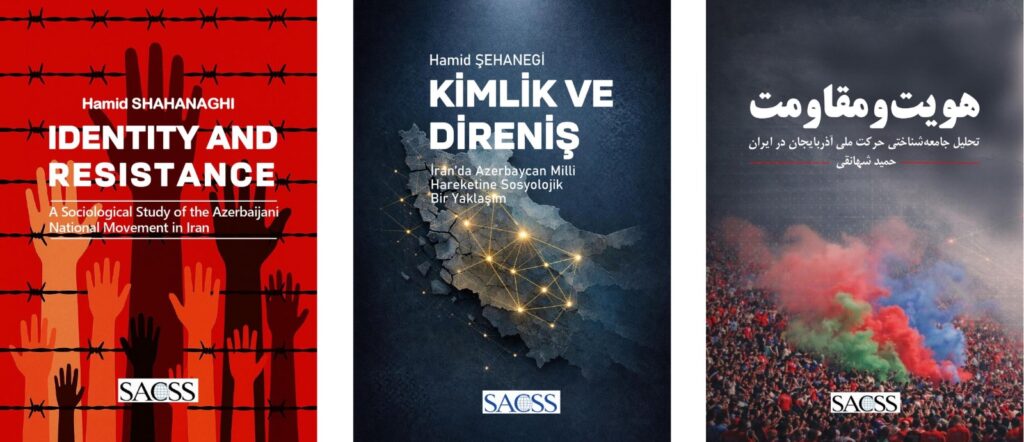
The book “Identity and Resistance: A Sociological Approach to the Azerbaijani National Movement in Iran” has been published with an analytical and interdisciplinary approach; the work examines nation-building policies, assimilation, and the civil resistance models of the Azerbaijani Turks in Iran.
This work analyzes the reaction and organization forms of marginalized identities, focusing on the centralized state structure, identity assimilation policies, and nation-building processes.
The book presents a sociological analysis of the South Azerbaijan national movement and particularly focuses on the civil resistance models of Azerbaijani Turks against the homogenization policies of the Islamic Republic of Iran. The author examines the dynamics of this movement within the broader framework of ethnic resistance and collective identity formation, utilizing field data, historical documents, discourse analysis, and his own decades of lived experience.
The work analyzes topics such as the formation of ethnic consciousness, the role of the diaspora, the influence of media and social networks, the place of the Tractor football club in the reconstruction of Turkish identity, and the relationship between religion and ethnicity in civil struggles. The book aims to present an alternative narrative to centralist narratives and to establish a theoretical framework for understanding the dynamics of ethnic resistance in authoritarian contexts.
“Identity and Resistance” is not limited to a historical narrative; it also systematically examines social dynamics, cultural forms, collective memory, the role of the diaspora, and the theoretical connections of social movements. Within this framework, the processes of civil disobedience, cultural revival, and the formation of political consciousness among Iranian Turks are meticulously analyzed.
Chapter list:
• Chapter I: Nation-building and the state in multi-ethnic societies
• Chapter II: Qajar nation-building and early forms of identity resistance
• Chapter III: The Pahlavi state, assimilation, and cultural oppression
• Chapter IV: The Islamic Republic of Iran and the continuity of the nation-building policy
• Chapter V: The cultural resistance of Turks and the transformation of the identity movement
• Chapter VI: The religious institution, the Turkish clergy, and the national movement
• Chapter VII: Tractor; football and the reconstruction of Turkish identity
• Chapter VIII: The South Azerbaijan diaspora
• Chapter IX: The South Azerbaijan National Movement: opportunities, threats, and challenges
About the Author:
Dr. Hamid Shahanegi is a sociologist and researcher specializing in ethnicity, culture, and media. With over thirty five years of experience in media, political analysis, and social research, he has published more than 15 books and dozens of scientific articles in the fields of sociology, anthropology, cultural diplomacy, minority studies, and civil movements. Dr. Shahanaghi is the director of South Azerbaijan Center for Strategic Studies (SACSS) in Istanbul.
This work is the product of the author’s field research, continuous observations, and theoretical interest concerning nation-building in Iran, ethnic discrimination, and the future democratic perspective for South Azerbaijan.
This book has been published simultaneously in Turkish, Persian, and English. Interested parties can obtain it through the following links:
Turkish version: https://l24.im/dgbsUQ
Persian version: https://l24.im/yY3QC0j
English version: https://l24.im/gBj9pW