Dr. Emre Chakir
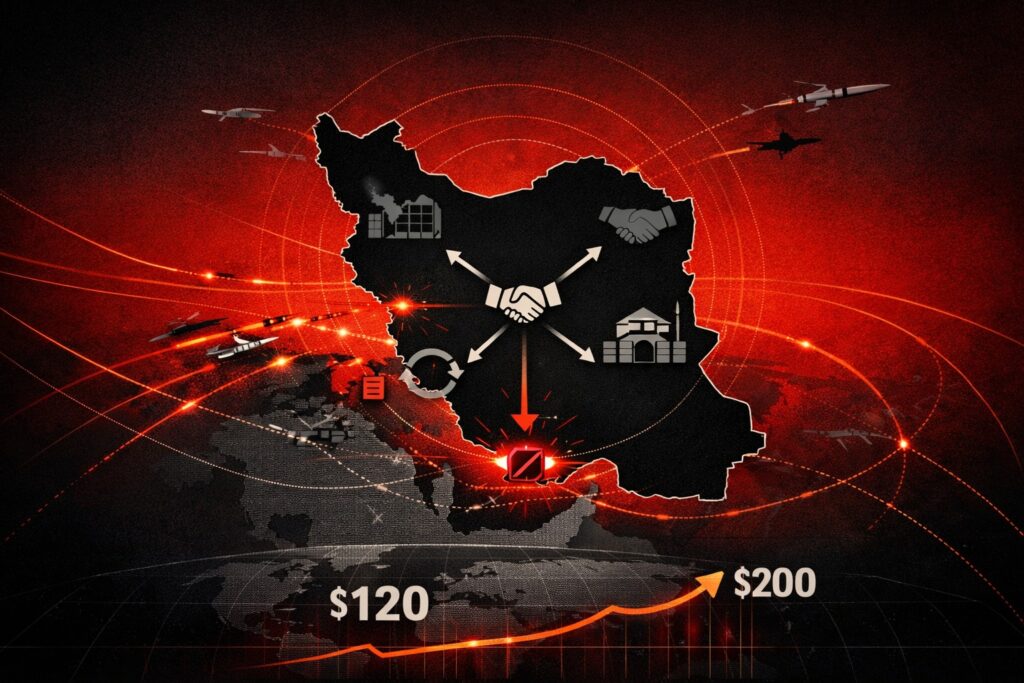
The military crisis that began on February 28, 2026, with the US-led “Operation Epic Fury” and Israel’s “Operation Roaring Lion,” transcends a limited conflict, representing the culmination of 47 years of confrontation between the Islamic Republic and the Western bloc. This war is a direct product of the failure of diplomatic efforts in 2025; the Muscat and Rome negotiations demonstrated that the gap between Washington’s insistence on the complete dismantlement of uranium enrichment and Tehran’s demand for the lifting of sanctions was unbridgeable. Developments on the ground indicate that the widespread protests in Iran during December 2025 and January 2026 transformed the White House’s calculations from an “arms control operation” into a “political engineering project”; as Trump, observing the depth of discontent, concluded that the regime was in its most precarious historical state.
The Strategic Divide Between Washington and Tel Aviv
Donald Trump aims in this war to solidify his position as the president who definitively resolved the “47-year Iranian threat.” His approach is a combination of maximal military intervention and deliberate ambiguity in diplomacy. Trump seeks the complete destruction of nuclear and missile capabilities and the elimination of proxy threats, but he always keeps an eye on the possibility of a “grand bargain” with a new leadership. For him, regime change must occur without ground invasion, through air power and by inciting a popular uprising, because his voter base (MAGA) is vehemently opposed to “forever wars.” In contrast, for Benjamin Netanyahu, this war is a historic opportunity to “permanently change the map of the Middle East” and guarantee his political survival in the 2026 elections. While Trump sees victory in weakening military capacity and returning to the negotiating table, Netanyahu aims for the complete collapse of the system and even lasting instability in Iran; because, in his view, an Iran grappling with civil war is less dangerous than a cohesive and hostile Iran. This divergence in perspective is also evident in the economic layer; Trump is highly sensitive to gasoline prices in the US, whereas Netanyahu prioritizes Israel’s security over fluctuations in global energy markets.
The IRGC’s Mosaic Defense Doctrine and the Succession Variable in Tehran
The Islamic Revolutionary Guard Corps (IRGC), relying on the “mosaic defense” doctrine, has divided its command structure into 31 independent provincial units. This aims to ensure that, in the event of a loss of communication with the capital or the assassination of senior leaders, each unit can continue fighting and insurgency self-sufficiently. This strategy has been implemented in the 2026 war through the extensive use of Shahed drones and Fattah-2 hypersonic missiles against Israeli infrastructure and US bases in the region. The killing of Ali Khamenei in the initial attacks has turned the succession crisis into a critical variable. The emergence of Mojtaba Khamenei as a central figure indicates the prioritization of a “revenge and survival” strategy. The new leadership team, including figures like Ali Larijani, has put forward three stringent conditions for ending the war: recognition of Iran’s sovereign rights, payment of war reparations, and international guarantees against future attacks. Relying on mosaic defense, the regime aims to prolong the war into a war of attrition, thereby utilizing economic pressure as a tool against the West.
Geoeconomic Consequences and the Role of Third Powers
The de facto closure of the Strait of Hormuz has created an unprecedented crisis in global energy security. Brent crude prices have surged to $120-$150 levels and are expected to reach $200 if the blockade continues. This disruption is not limited to oil; Qatar, which supplies 20% of the world’s liquefied natural gas (LNG), has suspended production due to drone threats, causing gas prices in Europe to rise by 300%. Furthermore, the interruption of one-third of the global helium supply from the Persian Gulf region has disrupted semiconductor and medical equipment manufacturing internationally. In the agricultural sector, a 30% jump in fertilizer prices (urea and ammonia) threatens global food security. These pressures have placed China, which sources 40% of its oil and 30% of its LNG from this region, in a contradictory position; Beijing, on one hand, condemns the US attacks, while on the other, it is under pressure to protect its energy lifelines. Russia, adhering to a policy of “sitting on the fence,” benefits from rising oil prices but is reluctant to see the complete collapse of its ally in Tehran.
The War’s Endgame: Analysis of Exit Scenarios and War Termination
According to field data, four possible paths exist for the conclusion of this war.
- The first scenario is decisive victory and a change in the power structure; in this scenario, airstrikes lead to the collapse of the security apparatus and a nationwide uprising. Desired by Netanyahu, this scenario carries the risk of a prolonged civil war and a massive refugee crisis.
- The second scenario is a limited agreement and rapid exit; Trump, after destroying a large portion of nuclear capabilities and assassinating key figures, declares a symbolic victory and strikes a deal with the new leadership, extracting extensive nuclear concessions in exchange for their survival. This path could restore stability to energy markets but would likely face fierce opposition from Israel.
- The third scenario is a war of attrition and a mosaic stalemate; Iran, relying on asymmetric warfare, prolongs the conflict, aiming to drive oil prices to unbearable levels and force the West to retreat without achieving clear political gains.
- The fourth and final scenario is the emergence of a military junta by the Revolutionary Guards; in this scenario, military commanders formally seize power, transforming Iran into a “garrison state” similar to North Korea, moving its activities deep underground and withdrawing from all international treaties.
In the final analysis, the key to ending the war lies in the balance between the “resilience of the Iranian regime” and the “tolerance threshold of the global economy for oil prices.”