Dr. Hamid Shahanaghi
The military developments of 2020 and 2023 in the South Caucasus cannot be read merely as a territorial shift or a tactical victory for the Republic of Azerbaijan in the Karabakh War. These events have created an epistemological, identity-based, and political rupture in the collective consciousness of the Turks of South Azerbaijan—a rupture that has activated deeper layers of history, collective memory, nation-building policies in Iran, and the logic of power in Eurasia. From the perspective of the “Center for Strategic Studies of South Azerbaijan,” these developments must be understood as a quiet revolution in national consciousness; a revolution emerging not from the streets, but from battlefields, media, historical narratives, and the redefinition of the “nation-state” relationship.
To understand the depth of this transformation, it is first necessary to return to the historical context, the epistemic structures of the Iranian state, and nation-building theories; for without these frameworks, the impact of Baku’s victories on South Azerbaijan will be understood only superficially and as event-driven.
The Legacy of Partition and the Formation of the “Historical Trauma of Bifurcation”
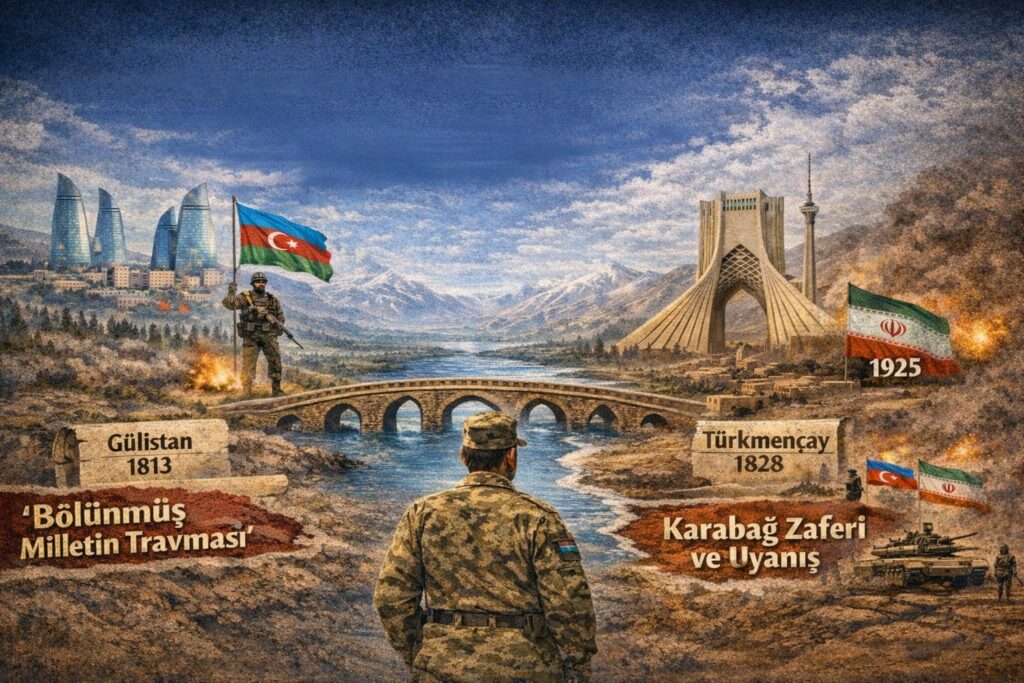
The division of Azerbaijan in the 19th century was not merely a boundary line on a map; it was the fragmentation of a civilizational, political, and linguistic unit. The treaties of Gulistan (1813) and Turkmenchay (1828) not only altered political sovereignty but also tore apart the social, economic, kinship, and cultural networks of a nation along the Aras River.
In the northern part, after a long period of Tsarist and then Soviet rule, an independent state with an Azerbaijani identity finally emerged in 1991—a state that, while fragile, corrupt, and weak in its early decades, possessed a structural capacity for indigenous nation-building. In contrast, the southern part, within the framework of Pahlavi Iran and later the Islamic Republic, became trapped in a project that can be termed “centralist, monolingual, and mono-narrative nation-building.”
This historical rift created a kind of enduring trauma in the collective memory of the Southern Turks: a sense of being separated from the “main body of the nation,” while simultaneously living under a powerful and centralized state that viewed any trans-national link as a security threat. This situation placed South Azerbaijan in a dual position: part of the political Iran, but on the margins of the identity-based Iran.
In different decades, this historical trauma manifested in various forms; from the Azerbaijan National Government in 1945 to the cultural movements of the 70s and 80s, and finally to the identity-oriented activism of the new generation in the 2010s and 2020s. However, prior to 2020, this consciousness was more cultural and symbolic than strategic and geopolitical. The Karabakh War transformed this status quo.
The Iranian State and the Logic of “Controlled Ethnic Demarcation”
The model of nation-building in Iran from the first Pahlavi era to the present has rested on three pillars:
- The Persian language as the axis of national unity
- Intense political-administrative centralization
- A unified historical narrative centered on cultural-civilizational Iranism
Within this framework, Azerbaijani Turkish identity was neither fully denied nor fully recognized; rather, it was kept in a state of “conditional tolerance.” The Iranian state has always attempted to reduce ethnic demarcations to the level of “harmless cultural differences” and prevent them from becoming a political project.
The concept of “Azeri” in official literature was a classic example of identity engineering: an attempt to separate the Turks of Iran from the Turkic world and sever their trans-national ties with Anatolia, the Caucasus, and Central Asia. This project was partially successful but never completely eliminated Turkish identity.
Until 2020, the Iranian government could manage the national consciousness of Turks at a manageable level through a combination of educational, security, and media policies. However, the victories of the Republic of Azerbaijan eroded this control, as a “successful kin-state” suddenly appeared in Iran’s neighborhood, challenging Tehran’s official narrative.
The 2020 War as a Moment of Collective Catharsis
The 44-day Karabakh War served as a moment of psychological liberation for South Azerbaijan. Prior to that, many Turks in Iran lived between two contradictory feelings:
- Pride in their Turkish identity
- But a sense of marginalization and historical defeat
Baku’s victory overturned this equation. The liberation of Shusha, Jabrayil, Fuzuli, and other regions was not merely military news; it showcased the image of a victorious, modern Turkic nation possessing an efficient state.
For the first time, many young South Azerbaijanis saw that “being Turkish” could be associated with technology, military power, smart diplomacy, and international success. This created a profound shift in collective self-perception: from a “discriminated minority” to “part of a great nation with a victorious state.”
The most symbolic scene was the raising of the Azerbaijani flag on the Khodaafarin Bridges; a point that for centuries symbolized separation suddenly became a symbol of union. For millions of Southern Turks, the Aras was no longer a border of severance, but a historical line that could one day acquire a new political meaning.
The Collapse of the “Azeri” Myth and the Return of the Name “Turk”
One of the deepest consequences of the Karabakh War was the transformation in the language of identity. Prior to 2020, many Azerbaijani elites in Iran still used the term “Azeri,” either out of expediency or due to the discursive pressure of the state.
However, after Baku’s victory, a widespread wave of returning to the word “Turk” took shape. This change was not merely linguistic; it was a symbolic political act. The slogan “Biz Türküq” (We are Turks) in stadiums, universities, and social media became a sign of identity reclamation.
At this stage, the ethnic demarcation became clearer: it was no longer about differences in dialect or local culture, but about membership in a broader civilizational world called the “Turkic World.” This confronted the Iranian nation-building project with a serious crisis.
The Kin-State and the Redefinition of North-South Relations
After 2020, the Republic of Azerbaijan gradually and more actively embraced the role of a “kin-state.” Ilham Aliyev’s speeches at the Organization of Turkic States, references to “40 million Azerbaijanis outside the borders,” and Baku’s media symbolism all indicated a change in approach.
This policy can be called “soft identity diplomacy”:
- Representation of South Azerbaijan in official media
- Symbolic references to southern cities in weather reports
- Emphasis on historical ties across the Aras
- Highlighting the concept of “South Azerbaijan” in official discourse
The result of this process was the erosion of mental borders. Many Southern Turks began to see themselves not merely as citizens of Iran, but as part of a trans-national nation whose political center of gravity is in Baku.
Removal of the Buffer Zone and Geopolitical Consequences
The 2023 operation and the collapse of Artsakh had profound consequences for Iran. For decades, Tehran utilized an Armenian buffer zone as a geopolitical dam between itself and the Turkic world. With the removal of this buffer, Iran was suddenly faced with an integrated border with the Republic of Azerbaijan—a state with deep ethnic ties to Iran’s internal population.
From a security perspective, this situation means an increase in Baku’s “potential identity influence” inside Iran. From an identity perspective, it means the physical and symbolic closer proximity of Southern Turks to their kin-state. This elevated ethnic demarcations from a cultural level to a political-geopolitical level.
Zangezur Corridor: From a Transit Project to a Machine for Producing National Consciousness
The Zangezur Corridor cannot be considered merely a transportation route; in practice, this project has become a catalyst for the geopolitical realignment of identity in northwestern Iran. To understand its effect on South Azerbaijan, one must view three levels simultaneously: economic, security, and symbolic.
A) Economic Level: Two Conflicting Logics of Development From Tehran’s perspective, Zangezur is viewed as a threat to “Iran’s vital geography” and a severance of the land connection with Armenia. However, in South Azerbaijan, this project is seen as a historical opportunity to escape developmental marginalization.
The provinces of East Azerbaijan, West Azerbaijan, Ardabil, and Zanjan, despite their prime geopolitical position, have largely held a peripheral status in the centralist development model over the past four decades:
- Limited industrial investment
- Dependence on transfer budgets from Tehran
- Absence of independent trade corridors
- Severance of direct access to Caucasus and Anatolian markets
In the mindset of local elites, Zangezur signifies three transformations:
- Turning Tabriz and Ardabil into a logistics hub between Turkey, the Caucasus, and Central Asia.
- Reducing economic dependence on Tehran.
- The possibility of forming a “regional Azerbaijani economy” beyond the framework of the Iranian state.
This has gradually created a shift in political loyalty priorities: a segment of the local society no longer defines its interests under the “Iranian national economy,” but under the “Turkic space economy.” This is exactly where cultural identity turns into geo-economic identity.
B) Security Level: The Aras Border as a Civilizational Contact Line Iran’s military maneuvers along the Aras (including “Conquerors of Khaybar”) demonstrate Tehran’s perception of danger: the northern border is no longer merely an external border, but a border between two rival identity projects.
Conversely, the joint exercises of Turkey and Azerbaijan sent a clear message: the Turkic world is preparing for a hardware presence in regional equations. This confrontation had three effects on Southern Turks:
- Securitization of identity: Being Turkic is no longer just a cultural matter; it is a security-political matter.
- Dualization of loyalty: A portion of the local society sees itself on the Baku-Ankara front, not the Tehran front.
- Normalization of the idea of new political demarcation: The Aras is gradually transforming in the collective consciousness from an “immutable border” to a “rethinkable border.”
C) Symbolic Level: Zangezur as a Narrative of Liberation In the discourse of national activists, Zangezur is no longer just a railway; it is a symbol of breaking the historical siege of South Azerbaijan. Just as Karabakh became a symbol of “liberating occupied territory,” Zangezur has become a symbol of the “geopolitical liberation of the South.”
This symbolization has elevated national consciousness from the level of cultural demands (language, education, media) to the level of a political-territorial project.
The Urmia Lake Crisis: From Environmental Disaster to Identity Politics
The drying of Lake Urmia has been the focal point for converting environmental suffering into ethnic political consciousness. In the collective memory of South Azerbaijan, this crisis is increasingly interpreted not as a “management error,” but as “structural violence by the center against the periphery.”
A) The Dominant Narrative in the South: Environmental Genocide In the discourse of activists, Urmia has become a symbol of three things:
- Tehran’s systematic neglect of Azerbaijan.
- Prioritizing military-regional projects over the welfare of local people.
- Conscious destruction of the ecosystem to weaken the sustainable settlement of Turks.
When compared with the rapid reconstruction of Karabakh in the North, this narrative built a deep emotional rift:
- Baku built up the ruins;
- Tehran destroyed the historical wetland.
This comparison has severely eroded the moral legitimacy of the Iranian state in the eyes of a segment of the Turkic community.
B) Urmia as the Moral Boundary of the Nation-State After 2020, every time images of the dried lake were published, images of the Karabakh being rebuilt were simultaneously reshared. The result of this visual juxtaposition was the formation of a powerful binary:
- The “responsible Turkic state” in the North
- The “indifferent Persian-centric state” in the South
This binary moved ethnic demarcation from the linguistic level to the moral-civilizational level.
Transformation of Civil Activism: From Culturalism to Sovereignty-Seeking
The Karabakh victories transformed the pattern of activism in South Azerbaijan. Before 2020, demands were primarily cultural:
- Teaching the mother tongue
- Local Turkic media
- Recognition of ethnic symbols
However, after 2020, demands gradually became more political:
- Regional self-management
- Cultural-administrative federalism
- And in part of the movement, independence or union with the North
A) Tabriz Yadegar-e Emam Stadium as a Street Parliament The Tabriz stadium has effectively become the largest public platform for Turkic identity. Slogans shifted from “Karabakh” toward “National Sovereignty.” The most important discursive transition was as follows:
- From “Either Karabakh or Death”
- To “Freedom, Justice, National Government”
This change indicates that the movement has shifted from cross-border solidarity to an internal project of power.
B) The 2022 (1401) Protests and the Priority of National Identity During the nationwide protests of 2022, South Azerbaijan showed a different pattern:
- Simultaneity with Iran’s national protests
- But with a specific Azerbaijani agenda
This showed that Turkic identity is no longer dissolved within the “Iranian opposition”; rather, it acts as an independent political actor.
The Iranian State’s Reaction: From Management to Suppression
Tehran, instead of structural reforms, chose the path of securitization:
- Arresting national activists
- Prohibiting Turkic symbols
- Labeling the movement as “Pan-Turkism” or “affiliated with foreigners”
This approach had three unintended consequences:
- Radicalization of the movement
- Strengthening of generational solidarity among the youth
- Transformation of ethnic demarcation into a line of political resistance
In practice, instead of narrowing the gap, the state deepened it.
Transformation of the Elites: From Reformism to Structural Breakdown
A significant portion of Azerbaijani elites who previously hoped for reforms within the framework of Iran changed course after 2020. Three prominent trends have emerged:
- True Federalism: Division of power, independent budget, and bilingual education.
- Cultural-Economic Confederalism: Institutional links with Baku without changing borders.
- Conditional Independentism: In the event of continued suppression, political separation.
This change indicates that the movement has passed the “protest” stage and entered the stage of designing the future.
The Rupture Scenario, Future Power Architecture, and the 2030 Horizon
The rupture scenario and the formation of an independent South Azerbaijan state cannot be understood as a “sudden event”; rather, it must be analyzed as a gradual process of the collapse of the existing identity-political order in Iran and the simultaneous rise of an alternative Turk-centric order. This process has three main drivers:
First, the legitimacy crisis of the central government. In the northwest, the Islamic Republic is recognized not only as an inefficient state but as an unjust, unaccountable state that does not represent local identity. The Lake Urmia crisis, economic discrimination, extreme centralization, and the suppression of cultural symbols have created a structural rift between the Turkic nation and the state that seems irreparable over time.
Second, the emergence of a powerful kin-state. After 2020 and 2023, the Republic of Azerbaijan has transformed into a victorious, self-confident state with military-diplomatic capacity. This state is not only an inspiring model but is gradually playing the role of an “identity center of gravity” for Southern Turks. In international relations literature, this can be seen as the formation of a “Kin-State Effect,” where a co-ethnic state strengthens the demands of an ethnic minority across the border.
Third, the geopolitical realignment of Eurasia. The Organization of Turkic States (OTS), the Middle Corridor, the Zangezur project, and Great Power competition have created a space where 19th-century borders are no longer considered “obvious” and unchangeable. Within this framework, South Azerbaijan has moved from an “internal Iranian issue” to a “regional Turkic world issue.”
The combination of these three factors forms the logic of the rupture scenario: If the central government does not reform and external-regional pressure increases, South Azerbaijan could enter the path of structural change.
Three Practical Paths for Realizing the Rupture Scenario
The scenario of independence or union with the North can itself be realized through three different paths. These three paths are not necessarily contradictory and may occur in combination.
Path One: Gradual Collapse of the Iranian State In this path, no major regional war occurs; instead, Iran undergoes erosion of central sovereignty due to economic, political, and social crises. Signs of this trend are already visible: chronic inflation, political instability, intermittent protests, ethnic rifts, and the state’s decreased ability to exercise unified control. In such a situation, South Azerbaijan could gradually enter a state of practical self-management:
- Local councils become more powerful
- Informal Turkic education expands
- Economic ties with Baku and Turkey are strengthened
- Turkic national symbols become normalized in public space This situation can be called “creeping independence”: without an official declaration of separation, the region effectively exits Tehran’s decision-making orbit. At a certain point, a formal request for autonomy or independence will be raised via local referendum or popular pressure.
Path Two: Major Regional Crisis In this scenario, a change in South Azerbaijan’s status is tied to a widespread geopolitical crisis; for example:
- Escalation of tension over the Zangezur Corridor
- A limited Iran-Azerbaijan conflict
- Or a proxy war in the South Caucasus If such a crisis occurs, the Aras border transforms from a political line into a military contact line. In this situation, Baku and Ankara could informally support the national demands of Southern Turks. Even without direct intervention, the deterrent effect of the Turkic world could tie Tehran’s hands against widespread suppression. In this path, South Azerbaijan might move toward forming a “temporary local administration,” similar to what has occurred in other autonomous regions of the world.
Path Three: Indirect Intervention of the Turkic World This path is not necessarily military, but primarily political-economic-cultural. The Organization of Turkic States could:
- Create extensive scholarships for southern youth
- Strengthen Turkic media
- Build Tabriz-Baku-Istanbul economic networks
- Define trans-border infrastructure projects As a result, South Azerbaijan gradually integrates into the institutional orbit of the Turkic world, even if it remains legally part of Iran. This situation would be a precursor to a future political rupture.
Architecture of the Future State of South Azerbaijan
If the rupture scenario is realized, the key question is: what shape will the future state take? Four possible models are conceivable:
Model One: Independent Republic of South Azerbaijan In this model, Tabriz becomes the political capital, and the governance structure is formed based on secularism, electoral democracy, and regional decentralization. The official language will be Azerbaijani Turkic, and Kurdish, Armenian, and Assyrian minorities will have guaranteed linguistic-cultural rights. The economy of this state will rest on three pillars:
- Transit (Zangezur and the Middle Corridor)
- Light industry and automotive joint ventures with Turkey
- Modern agriculture and the restoration of Lake Urmia
Model Two: Confederal Union with the Republic of Azerbaijan In this model, South Azerbaijan does not gain full independence but enters a bilateral confederation with Baku: separate armies but coordinated foreign policy; a common or semi-common currency; and a single economic market. This model is attractive to the Turkic world as it upgrades “one nation–two states” to “one nation–two linked states.”
Model Three: Deep Federalism within the Framework of Iran If Tehran accepts radical reforms, a model of true federalism might be implemented: an Azerbaijani regional parliament, an independent budget, local police, and official Turkic education. This model halts independence but solidifies Turkic national identity.
Model Four: Gradual Annexation to Baku In the event of a total collapse of the Iranian state or a security crisis, the possibility of full union between the South and North is also raised; a scenario that triggers the highest geopolitical sensitivity.
The Role of the Organization of Turkic States (OTS)
The OTS will play a key role in this process. It can recognize South Azerbaijan as a “cultural part of the Turkic world,” even if it is not an officially independent state. The three main tools of the OTS are:
- Cultural Tool: Joint education, a single Latin alphabet, Pan-Turkic media.
- Economic Tool: Middle Corridor, joint investment, regional market.
- Soft Security Tool: Symbolic maneuvers, informal defense cooperation. By the 2030 horizon, the OTS will likely transform from a purely cultural organization into a semi-military-economic block.
The Position of Great Powers
- United States and European Union: The West will look at South Azerbaijan not as a primary goal, but as a tool for pressure on Tehran and the containment of Russia. Overt support for independence is unlikely, but implicit support for linguistic rights and local autonomy is probable.
- Russia: Moscow is concerned about Pan-Turkism, but if Iran is weakened, Russia might make a deal with Baku to maintain its influence in the Caucasus. Therefore, absolute Russian opposition to changes is not certain.
- China: China prioritizes the stability of trade corridors. If Zangezur benefits regional trade, Beijing could effectively support it, even if it is to Iran’s detriment.
South Azerbaijan in the 2030 Horizon
By 2030, four trends are highly probable:
- The institutionalization of Turkic identity in the South; even if independence does not occur, the Turkish language will expand in schools, universities, and media.
- Deep economic linkage with Baku and Ankara; Tabriz becomes a regional hub.
- Further weakening of Tehran’s central authority in the northwest; full security control will be practically impossible.
- An increase in the geopolitical weight of South Azerbaijan in Turkic world equations.
Final Strategic Conclusion
The 2020 and 2023 Karabakh victories were not merely wars; they were identity-geopolitical turning points for the Turks of South Azerbaijan. These events:
- Transformed national self-confidence
- Clarified ethnic demarcations
- Eroded the legitimacy of the Iranian nation-building model
- And turned South Azerbaijan into a strategic variable in Eurasia
The scenario of rupture and the formation of an independent state is not a fantasy, but a real possibility within the context of regional developments. If Tehran continues the path of suppression and centralization, the likelihood of this scenario realizing by 2030 will increase. If deep reforms occur, true federalism could replace rupture.
In either case, one reality is irreversible: South Azerbaijan will not return to its pre-2020 state. Turkic identity is solidified, national consciousness is awakened, and the Turkic world is redefining its map of power.
This report indicates that the future of Iran, the Caucasus, and the Turkic world is strictly tied to the management of the South Azerbaijan issue—an issue that is no longer merely internal but part of the new Eurasian order.