Dr. Emre Çakır:
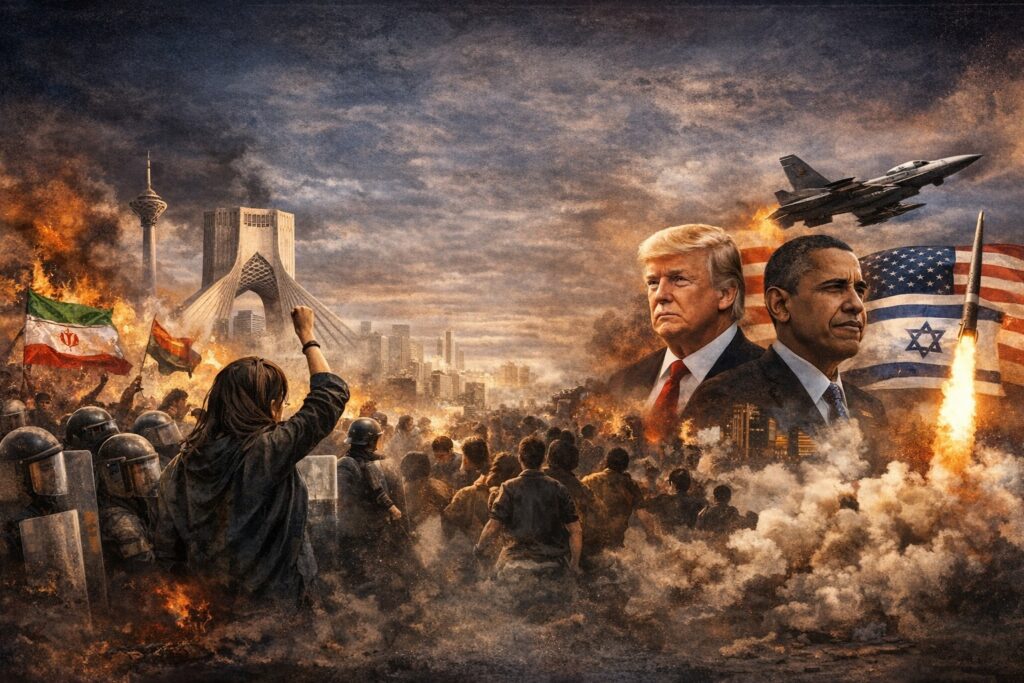
It is not possible to view the recent protests in Iran merely as a repetition of previous waves of discontent. What is visible today in the streets, on social networks, and even in the meaningful silences of society is the product of the intersection of three simultaneous crises: chronic economic erosion, the collapse of political trust, and the feeling of being caught in the midst of geopolitical storms. This combination distinguishes the new protests from the 2022 (1401) uprising—not only in terms of demands, but also in terms of collective mood and the horizon of expectations.
In 2022, the protests were прежде all a moral–generational reaction to issues of dignity, lifestyle, and the state’s symbolic violence. The slogan “Woman, Life, Freedom” emerged from the lived experiences of the younger generation and carried a heavy burden of values and identity. By contrast, the recent protests draw not so much from an explosive anger as from a deep exhaustion and a sense of being “blocked.” This time, the street is not only a space of shouting but also a space of reckoning: Is it worth staying? Do protests produce results? And has the outside world changed in a way that can generate new hope?
The outside world; from inspiration to illusion
In this atmosphere, the way protesters—and, of course, those in power—view international developments is more sensitive than ever. Every piece of news, every statement, even every rumor can acquire symbolic weight. A striking example is the narratives circulating in the Persian-language media space about developments in Latin America, especially Venezuela. Regardless of the accuracy or inaccuracy of some of these claims, a prevailing perception among part of the Iranian public is that the United States has adopted a more aggressive and less cautious stance toward authoritarian governments compared to the past.
Whether this perception is correct or not is beside the point; what matters is that politics is shaped not only by objective facts but also by collective perceptions. For some protesters, these narratives convey the message that “the global order is changing” and that perhaps the era of immunity for repressive states is coming to an end. Conversely, for those in power, the same narratives can serve as a justification for hardening a security-oriented outlook and foregrounding the “external enemy.”
Trump, Obama, and the memory of protest
Comparisons between the reactions of U.S. presidents to protests in Iran are also part of this political memory. In 2009 (1388), Barack Obama spoke cautiously. He feared that overt American support would quickly weaken the “Green Movement” by branding it as “foreign-directed.” Although this approach had diplomatic logic, it was registered in the minds of many Iranian protesters as being “left alone on the ground.”
By contrast, Donald Trump has used a harsher and more direct language. His verbal support for Iranian protesters has been encouraging for part of society and anxiety-inducing for another part. Iran’s historical experience has shown that external support is a double-edged sword: it can boost morale, but it can also make the cost of repression more justifiable for those in power. What distinguishes today from 2009 is this: Iranian society is no longer naïve enough to equate external support with salvation, but neither is it indifferent enough to consider it entirely irrelevant.
The shadow of war and the securitization of politics
In addition to these factors, regional military tensions, including direct and indirect confrontations between Iran and Israel play an important role in shaping the protest atmosphere. Even a short or limited war has long-term psychological effects. War changes the language of politics: priorities become securitized, critical voices are marginalized, and every demand can be interpreted as a “threat to stability.”
For a protesting society, this creates a painful contradiction. On the one hand, economic and political pressure pushes people into the streets; on the other hand, fear of instability, war, and collapse makes the same people more cautious. The result is neither a total eruption nor complete silence; rather, it is periodic, fragmented, and wearing protests.
The future; between cautious hope and deep suspicion
Today’s protests in Iran are more than ever tied to the question of “horizon.” In 2022, many people simply wanted their voices to be heard. Today, the question is: What comes after protest? Is there an alternative that can generate legitimacy from within while also increasing the external cost of repression? Has the world truly changed, or have narratives merely become more visible?
What is certain is that Iran has entered a political phase in which no actor neither the state, nor the protesters, nor external powers, fully controls the situation. Protests will continue, but not necessarily in an explosive form. This is a marathon, not a sprint; a marathon whose outcome will be determined not only in the streets, but also in the economy, historical memory, and global developments.