An Analytical Study on Pişeveri’s Historical Mission
Dr. Pervane Memmedlli
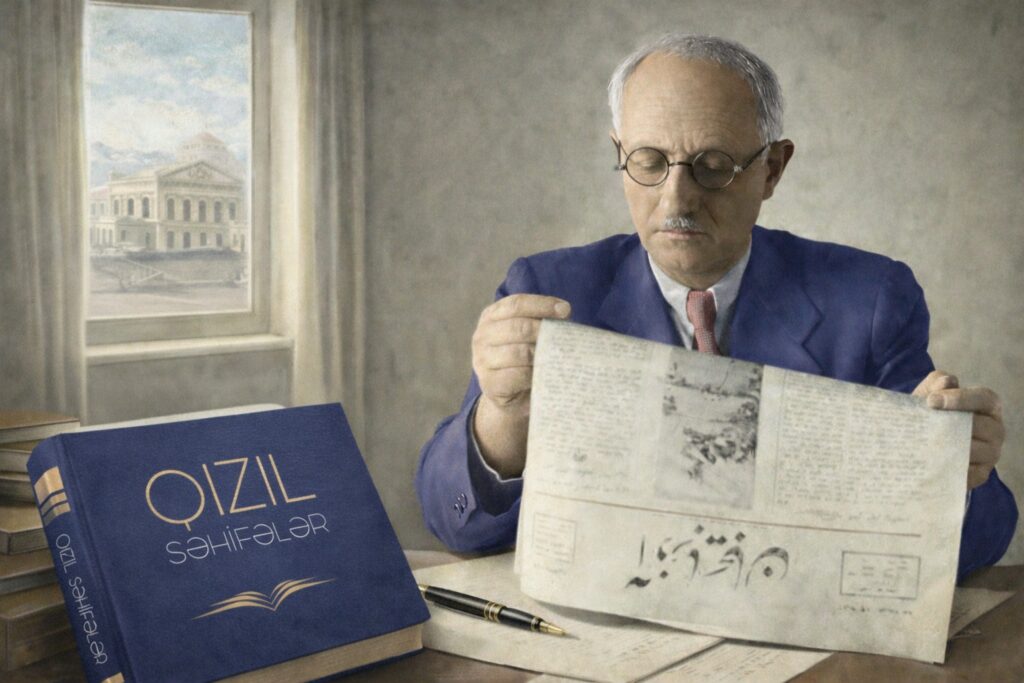
The National Government established in South Azerbaijan between 1945 and 1946 represents not merely a regional political transformation, but also the first comprehensive process of state formation and identity construction of Azerbaijani Turkdom in the modern era. The most concrete and enduring intellectual legacy of this period is the work titled “Qızıl Səhifələr” (From the History of the Struggle of the Azerbaijani People on the Path of National Liberation), printed in 1946 at the “Elmiyye” printing house in Tabriz. Examined in depth by Dr. Pervane Memmedli, this work constitutes a vivid chronicle encompassing the political-journalistic legacy of Seyid Cafer Pişeveri, the founding leader of the National Government, the core programs of the Azerbaijan Democratic Party (ADP), and the people’s struggle for language, identity, and sovereignty. This report provides an in-depth analysis of the content of this work, its historical context, and its significance for South Azerbaijan strategic studies.
The Emergence of the National Government and the Historical Background of “Qızıl Səhifələr”
The National Government proclaimed in South Azerbaijan on 12 December 1945 (21 Azer 1324) was not an accidental political eruption, but rather the outcome of a centuries-long quest for freedom and an accumulated social will against the centralist oppression of the Pahlavi regime. The geopolitical vacuum created by the Second World War, combined with the occupation of Iran by Soviet and British forces in 1941, provided Azerbaijani Turks with a suitable ground to determine their own destiny.
The work “Qızıl Səhifələr” brings together texts written by Pişeveri himself during this very “heated” period, when he stood at the center of events. The digitization of the book in 2012 and its recent republication by the Nizami Ganjavi Institute of Literature of the Azerbaijan National Academy of Sciences (ANAS) have enabled these historical truths to reach modern readers and researchers. The work is not merely a dry compilation of documents, but rather an encyclopedic source that contains the ideological genetics of the National Government.
| Chronology of the Institutionalization of the National Government (1945) | Major Developments and Decisions |
| 3 September 1945 | The Azerbaijan Democratic Party (ADP) was founded and the Müraciətnamə (Appeal) was published. |
| 2 October 1945 | The First Congress of the ADP convened with 277 delegates; the statute and program were adopted. |
| 20 November 1945 | The National Congress convened in Tabriz; a historic 14-article declaration was adopted. |
| 12 December 1945 | The 21 Azer Revolution took place; the National Government was established under Pişeveri’s leadership. |
| 6 January 1946 | Turkish (Azerbaijani Turkish) was declared the official state language. |
Pişeveri’s Philosophy: Creating History Rather Than Writing It
The fundamental philosophical foundation of “Qızıl Səhifələr” is the principle articulated by Pişeveri in the preface of the work: “We are not writing history; we are creating history.” This approach represents not only a political act but also an intellectual revolution. While leaving the scientific-historical depiction of events to future historians, Pişeveri argues that the duty of his generation is to construct that history firsthand.
This perspective marks a new stage in Azerbaijani political thought. According to Pişeveri, the primary duty of national forces is not theoretical debates, but the establishment of state mechanisms, the protection of the people’s rights, and the registration of national existence. The purpose of writing the book is defined not as “fame” but as “serving the national struggle.” This means that every line written by the leader’s pen functions both as an ideological weapon and as an indelible record of memory for future generations.
Another striking aspect of Pişeveri’s texts is his effort to revive the people’s historical memory. By grounding the Azerbaijani people’s struggle in ancient roots, he emphasizes the continuity of the movement. By invoking figures such as Sattar Khan and Sheikh Mohammad Khiabani, he positions the National Government as a link in this chain of heroism. This strategic approach aims to root the legitimacy of the movement in the conscience and history of the people.
“Müraciətnamə” as an Ideological Manifesto
The Müraciətnamə, the founding declaration of the ADP, constitutes the backbone of “Qızıl Səhifələr.” This document is not merely a party program, but also a doctrine of national liberation. Its language is simple enough to address the lowest strata of society (peasants and workers), yet politically sophisticated enough to convey messages to the international public.
The core elements emphasized in the Müraciətnamə reflect a pragmatic approach aimed at uniting the people:
- Populism and Social Justice: Organizing the collective reaction of the people against corruption, unemployment, and arbitrary governance of the Tehran government.
- National Identity and Language: Defending at the highest level the right of Azerbaijanis to receive education in their own language and to preserve their identity.
- Local Sovereignty: Advocating the principle of self-administration (autonomy) for Azerbaijan within the territorial integrity of Iran.
With this declaration, Pişeveri laid the foundations of a social-democratic and populist state model rather than a populist rhetoric. His call was directed not only at political elites, but also at the masses crushed under the hardships of daily life. This explains how the ADP rapidly transformed into a mass party and gained broad popular support in a very short period.
The Language Question and the Rebuttal of Ahmed Kasravi’s “Azeri” Theory
One of the deepest polemical domains of “Qızıl Səhifələr” concerns language and ethnic identity. In this work, Seyid Cafer Pişeveri sharply and rationally criticizes the “Azeri” theory of the prominent Iranian historian Ahmed Kasravi. In his 1925 publication, Kasravi claimed that Azerbaijani Turkish was a “foreign” language imposed on the people through the Mongol invasion, that the people’s true origin was Iranian, and that their original language was “Azeri,” a dialect of Persian.
Arguments on the Antiquity and Naturalness of the Language
Pişeveri refutes Kasravi’s theses through historical and sociological evidence:
- Natural Development: It is impossible for a people’s language to be forcibly changed in a short period. It is illogical to assume that nomadic tribes such as the Mongols could impose their language (even if they had a developed one) on a civilized society like Azerbaijan.
- The People as Witnesses: There is no trace in any village or city of Azerbaijan of a language called “old Azeri”; the only language spoken by the people for a thousand years has been Turkish.
- Literary Language vs. Mother Tongue: Pişeveri finds it “ridiculous” that Kasravi considers the fact that some Azerbaijani poets (Nizami Ganjavi, Saib Tabrizi) wrote in Persian as proof of their “Persianness.” Just as Ibn Sina’s writing in Arabic did not make him Arab, the use of Persian—the court language of the time—by Azerbaijani poets did not alter their ethnic identity.
Nizami Ganjavi and the Debate on National Identity
Pişeveri also addresses the claims of Persian chauvinists who assert that Nizami was from “Qom” in order to appropriate him. He emphasizes that Nizami was born and lived in Ganja and that the nature descriptions in his works are entirely specific to the geography of Azerbaijan. Nizami’s use of Persian was a necessity and a result of the literary prestige of his era. Pişeveri compares this situation to his own Persian articles written in the newspaper Ajir, arguing that the use of a language as a tool does not make the author belong to that nation.
| Comparative Identity Analysis | Ahmed Kasravi’s Approach | Response of Pişeveri and the National Government |
| Origin of the Language | Persian-based “Azeri” dialect | Ancient and independent Azerbaijani Turkish |
| Ethnic Origin | Turkic-speaking Iranians (Aryan origin) | A Turkic nation with historical continuity |
| Education Policy | Uniform nation-building through Persian | Mother-tongue education and cultural pluralism |
| Nizami Ganjavi | Iranian-Persian poet | Authentically Azerbaijani-Turkic poet |
Socio-Economic Transformation and Practices of Statehood
“Qızıl Səhifələr” presents evidence proving that the National Government was built not only on romantic nationalism but also on pragmatic governance and social justice. Avoiding dogmatic socialism, Pişeveri pursued a “third way” that preserved market balances while centering public welfare.
Land Reform and Agricultural Development
The most radical step of the government was the land reform that struck at the centuries-old feudal land system. During the process initiated in the winter of 1945:
- The lands of large landlords (arbablar) who had left the region and of the Shah were nationalized.
- Approximately 257,066 square kilometers of fertile land were distributed free of charge to 209,000 landless or small-holding peasants.
- State support was provided through seed distribution, repair of irrigation canals, and provision of agricultural machinery.
Workers’ Rights and Social Security
The National Government adopted a “Labor Law” that was revolutionary for the Middle East at the time. Through this law:
- An 8-hour workday limit was introduced.
- Weekly rest and annual paid leave were legalized.
- A minimum wage was established and compulsory insurance for workers was initiated.
- Child labor (under the age of 14) was strictly prohibited.
Women’s Rights and Gender Equality
The South Azerbaijan National Government possessed a progressive structure that granted women the right to vote and be elected much earlier than in the rest of Iran. In 1945, women voted for the first time and began working in state institutions. The establishment of the “Azerbaijan Women’s Club” and the representation of more than 300 women within the “National Army” demonstrate the depth of social modernization.
Cultural Renaissance: Nationalization of Education and Arts
According to Pişeveri, the true independence of a nation is measured by its freedom in education and culture. The educational reforms documented in “Qızıl Səhifələr” succeeded in shaking the Shah regime’s twenty-year assimilation policy within a single year.
Mother-Tongue Education and Academic Advances
With the historic decision taken on 6 January 1946, Azerbaijani Turkish was declared the official state language, and the transition to mother-tongue education began in all schools.
- Tabriz State University: Opened on 6 June 1946 as the first modern university of South Azerbaijan.
- Textbooks: Thousands of textbooks in the mother tongue were printed in a very short time, and teacher-training courses were established.
- Mobile Schools: Mobile classrooms and public libraries were established for children in rural areas.
The Role of Art and Media
The National Government regarded art as an aesthetic form of political struggle. The opening of the Tabriz State Theater, the establishment of the National Philharmonic, and the launch of Azerbaijan Radio broadcasts (4 July 1946) played a vital role in disseminating national consciousness among the masses. Intellectuals such as Suleyman Rustam, Mirza Ibrahimov, and Mohammad Biriya were among the architects of this cultural awakening.
| Cultural and Social Institutions (1945–1946) | Function and Contribution |
| Tabriz State University | Conducting scientific research in the national language |
| Azerbaijan State Theater | Bringing national plays and operas to the public |
| Azerbaijan Women’s Club | Integration of women into social and political life |
| National Army (Fidais) | Voluntary popular defense force and maintenance of public order |
| Mobile Hospitals | Providing healthcare services to villages and rural areas |
Institutional State-Building and the Legal Framework
Contrary to external criticisms, the National Government was not a chaotic structure but a state with legal foundations. “Qızıl Səhifələr” contains an extensive legal archive ranging from the internal regulations of the National Assembly (Milli Majlis-i Azerbaijan) to municipal election laws.
The National Assembly and Administrative Structure
Opened on 21 December 1945, the National Assembly functioned as the supreme organ representing the will of the people. The government’s nine-member cabinet (Interior, Education, Justice, etc.) was accountable to this assembly. As a strategic decision aimed at preserving Iran’s territorial integrity, ministries of Foreign Affairs, Defense, and Foreign Trade were not established, and these authorities were left to the central Tehran government.
Public Order and the Fight Against Corruption
The government enacted extremely strict laws against bribery and abuse of power. Popular militias known as “Fidai” units ended gendarmerie oppression and ensured public order in cities and villages. In addition, prices of basic necessities were frozen to ensure food security, and severe penalties were imposed on black marketeers.
Geopolitical Constriction and the Tragic End of the Movement
The existence of the National Government coincided with one of the first major crises of the Cold War that followed the Second World War. The Soviet Union’s pursuit of oil concessions in northern Iran and its military presence constituted both the movement’s greatest support and its greatest vulnerability.
With pressure from Western powers (the United States and the United Kingdom) and the withdrawal of Soviet forces in mid-1946, the National Government was confronted by Tehran’s central army. Although Pişeveri made certain concessions to prevent bloodshed, the government was overthrown when the central army entered Tabriz in December 1946. During this process, thousands of people were massacred, books were burned, and mother-tongue education was banned. The reason “Qızıl Səhifələr” is regarded today as a “treasure” is that it is one of the rare works salvaged from this destruction and documents the will of the people.
Strategic Assessment and Conclusion
“Qızıl Səhifələr” and the experience of the National Government represent not merely nostalgia but a roadmap for the future of South Azerbaijan strategic studies. Pişeveri’s manifesto demonstrates how a people, even under oppression, can institutionalize, transform its language and culture into state apparatuses, and build governance structures.
Based on our analysis, the following key conclusions can be drawn:
- Identity Construction: The National Government registered the historical and scientific legitimacy of Azerbaijani Turkdom against fabricated theories such as “Azeri.”
- Model of Modernization: This secular model, grounded in gender equality and social justice, remains a progressive example for the Middle East even today.
- Commitment to the Rule of Law: The movement’s greatest achievement was its ability to transform armed struggle into a parliamentary and administrative order within a short time.
- Cultural Resilience: The revival of “Qızıl Səhifələr” seventy years later is the strongest proof that national consciousness and language cannot be eradicated through physical repression.
Seyid Cafer Pişeveri’s mission of “creating history” continues to live on in the democratic and national demands of the people of South Azerbaijan today. “Qızıl Səhifələr” remains the unextinguished torch of this struggle and the unshakable fortress of national memory.