An Analysis from the Perspective of International Security and Sociopolitical Stability
Dr. Yashar Namdar
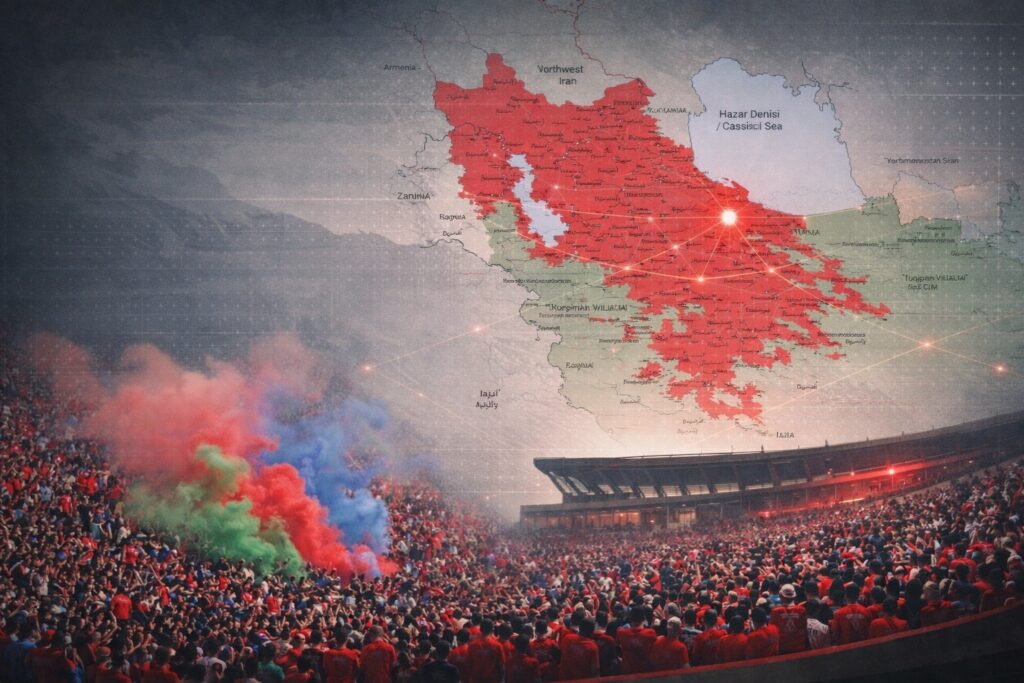
In modern political science and international relations, sport is no longer regarded merely as a field of entertainment or competition, but rather as one of the most powerful arenas for the expression of suppressed collective identities, political demands, and ethnic mobilization. In the northwestern region of the Islamic Republic of Iran known as South Azerbaijan, Tractor Football Club (formerly Tractor Sazi FC) has gone far beyond being a conventional football team and has become the “national” representative of a people and the principal platform of their civil rights struggle. Based in Tabriz, this club functions as a resistance anthem reflecting the collective will of a population of nearly 40 million against the centralist and Persian-centric assimilation policies pursued by the Iranian state for decades.
This analysis examines the Tractor phenomenon from sociological, demographic, and geopolitical perspectives, placing the club’s impact on international strategic balances and its central role in the legitimate struggle of South Azerbaijani Turks within an academic framework. Tractor’s success is not measured merely by scores on the pitch, but by the manifestos of freedom rising from the stands of Sahand Stadium, breaking through Tehran’s walls of censorship and reaching the world.
Football as a Political Arena and Identity Formation in South Azerbaijan
In authoritarian environments such as Iran, where political organization is violently suppressed and independent media do not exist sports stadiums function as “public gathering spaces” and “arenas of political struggle.” Although Tractor was founded in 1970 under an industrial corporation, since the late 2000s it has increasingly become the central symbol of ethnic identity. This transformation is the result of Azerbaijani Turks’ efforts to preserve their language, culture, and political existence.
Supporting Tractor is not merely a sporting preference; it is the construction of an “alternative identity.” This identity stands in opposition to the Tehran-centered hegemonic narrative and draws its roots from the Turkish language and history. Every chant in the stadium allows supporters to reinforce their sense of “we” against the central authority defined as “the other.”
Strategic and Identity-Based Comparison of Major Football Clubs in Iran
| Club Name | Headquarters | Core Identity Focus | Political Role | Support Base |
| Tractor SC | Tabriz | Turkic / Azerbaijani identity | Civil rights and resistance | Regional & ethnic (Global Turkic world) |
| Persepolis FC | Tehran | Persian / Central state | Regime legitimacy and populism | National (Tehran-centered) |
| Esteghlal FC | Tehran | Aristocratic / state tradition | Bureaucracy and status quo | National (institutional) |
| Sepahan SC | Isfahan | Regional / industrial | Display of economic power | Local (Isfahan-centered) |
The most fundamental feature that distinguishes Tractor from other clubs is the way its supporters use the stadium as a space of “social capital” and “mass mobilization.” For Tractor supporters, football is not merely a game; it is a peaceful form of protest through which fundamental human rights, such as education in the mother tongue and democratic freedoms are demanded.
Linguistic Rights and the Sociological Impact of Systematic Assimilation
Although Article 15 of the Constitution of the Islamic Republic of Iran permits the use of regional languages in education and media, in practice pressure on Azerbaijani Turkish continues. The chant most frequently heard at Tractor matches, “Schools must exist for everyone in the Turkish language” is a rebellion against this legal vacuum and the systematic obstacles imposed by the state.
The exclusion of Azerbaijani Turkish from the public sphere is interpreted as an attempt to erase a people’s historical memory. Tractor, however, functions as a “linguistic shield” against these assimilation policies. Supporters consciously use their dialects and cultural symbols during matches, neutralizing the state’s homogenization efforts.
Minority Policies and Linguistic Injustice in Iran
The gap between minority rights in Iran reveals the state’s security perception and strategic priorities. While Turks, who number nearly 40 million are denied the right to education in their mother tongue, much smaller minority groups (such as Armenians) are permitted to operate their own schools and cultural institutions. This is interpreted as a form of “demographic fear” and “strategic balancing.”
| Community | Estimated Population | Education Rights | Cultural Representation |
| Azerbaijani Turks | ~40,000,000 | Prohibited / Obstructed | Tractor & civil society |
| Armenian minority | 60,000–80,000 | Free (own schools) | Officially approved institutions |
| Kurdish minority | ~8,000,000 | Restricted / suppressed | Political and cultural resistance |
This unjust distribution demonstrates that the demands of Tractor supporters are not emotional, but are grounded in legal and rational foundations. As stated in UN Human Rights Council reports, ethnic minorities in Iran are subjected to systematic discrimination. Tractor is the arena where the cold statistics in these reports turn into flesh-and-blood reality.
Mass Sociology and Statistical Representation Analysis
When the presence of Tractor supporters in stadiums is analyzed through sampling methods used in social sciences, it becomes clear how large a population this movement represents. Statistical models such as those of Cochran, Morgan, and Krejcie explain how a limited group can provide reliable conclusions about a large population.
Sample Size and Representational Power (Krejcie & Morgan Formula)
The minimum sample size (s) required to represent the opinions of a population (N) is calculated by the formula:
s=X2⋅N⋅P(1−P)d2(N−1)+X2⋅P(1−P)s = \frac{X^2 \cdot N \cdot P (1 – P)}{d^2 (N – 1) + X^2 \cdot P (1 – P)}s=d2(N−1)+X2⋅P(1−P)X2⋅N⋅P(1−P)
Where:
- X² = Chi-square value for 1 degree of freedom at the 95% confidence level (3.841)
- N = 40,000,000 (estimated Turkish population in Iran)
- P = 0.50 (assumed proportion to maximize sample size)
- d = 0.05 (margin of error)
According to this calculation, a sample of only 384 people is sufficient to understand the tendencies of a population of 40 million. The 120,000 people who fill Sahand Stadium exceed this statistical requirement by hundreds of times. Therefore, the slogans rising from the stadium do not reflect “a random group of fans,” but the undeniable collective will of the people of South Azerbaijan.
Demographic and Socio-Economic Profile of the Support Base
Research shows that Tractor support spans all layers of society. This proves that the club is not merely a sports team but a model of a “micro-society.”
| Demographic Group | Percentage Viewing Tractor as an Identity Representative | Primary Expectation |
| Youth (<30 years) | 78% | National identity & modern freedoms |
| Women supporters | 65% | Gender equality & mother-tongue rights |
| Workers & farmers | 82% | Economic justice & democratic representation |
| Academics & intellectuals | 72% | Cultural autonomy & linguistic freedom |
These figures demonstrate that the social wave generated by Tractor is not a passing trend but the product of a deeply rooted political consciousness. The 78% rate among youth is the clearest indicator that this movement will grow even stronger in the future.
Environmental Activism: Lake Urmia and an Existential Threat
For the people of South Azerbaijan, Tractor is not only a cultural platform but also the voice of a struggle for survival. The drying up of Lake Urmia, one of the world’s largest salt lakes, constitutes a threat of “ecological genocide” for the region. Destroyed by misguided dam policies and central government negligence, the lake has become one of the most prominent protest themes at Tractor matches.
Slogans such as “Lake Urmia gives life, the parliament drains its blood” and“Azerbaijan is awake, it stands with Lake Urmia” demonstrate how environmental awareness has fused with ethnic identity.
The drying of Lake Urmia is not a natural disaster but the result of political decisions that directly threaten the agriculture, health, and future of millions of Turks living in that geography. In this context, Tractor supporters, by defending ecological rights, are in fact defending their own living space.
Gender, the “Noor Plan,” and Women’s Resistance
The struggle for women’s rights in Iran has become an international issue especially since 2022. Within the process launched by the “Woman, Life, Freedom” movement, South Azerbaijani women are waging a double struggle against both gender-based repression and ethnic discrimination. The stands of Tractor have become one of the most symbolic arenas of resistance against the ban on women entering stadiums.
At a time when Iranian authorities, under the so-called “Noor Plan,” have intensified control over women’s clothing using digital surveillance tools (facial recognition technologies, etc.), the presence of women supporters in stadiums has become vitally important. 65% of female supporters defend both their mother-tongue rights and women’s rights through Tractor. This demonstrates how inclusive and progressive the Tractor movement truly is.
Geopolitical Perspective: The Organization of Turkic States and the Aliyev Doctrine
The issue of South Azerbaijan is no longer merely an internal matter of Iran; it has become a regional security and diplomatic question. The Republic of Azerbaijan and the Republic of Türkiye are the most critical actors in this process.
The 2022 Samarkand Summit and Aliyev’s Historic Statement
The 9th Summit of the Organization of Turkic States (OTS) held in Samarkand on 11 November 2022 marked a turning point in which the rights of South Azerbaijani Turks were raised at the highest international level. President Ilham Aliyev stated:
“The Turkic world is not limited to the borders of independent Turkic states. The time has come for our Organization to focus on protecting the rights, security, and national identity of our compatriots living outside the Turkic world. Unfortunately, the vast majority of the 40 million Azerbaijanis living outside Azerbaijan are deprived of education in their mother tongue.”
While this statement caused serious discomfort in Tehran, it sent a powerful message to the people of South Azerbaijan that they were not alone. This new approach, what may be called the Aliyev Doctrine shows that Azerbaijan’s foreign policy has elevated the ideal of Azerbaijanism beyond national borders.
Strategic Positions of Regional Actors
| Actor | Strategic Approach | Policy toward Tractor & South Azerbaijan |
| Republic of Azerbaijan | Active and supportive | Cultural and political backing under the “One Nation” principle |
| Republic of Türkiye | Balanced and cautious | Protecting cultural rights while maintaining trade |
| Organization of Turkic States | Institutional and inclusive | Making the rights of kin communities a shared agenda |
| Islamic Republic of Iran | Reactive and repressive | Security-based policies and continued assimilation |
Türkiye, while protecting its 530-kilometer border with Iran and $5.6 billion trade volume in 2024–2025, is also concerned about potential migration waves arising from regional instability. However, during Hakan Fidan’s tenure as Foreign Minister, Türkiye’s integration with the Turkic world has deepened, increasing its soft power capacity regarding South Azerbaijan.
Human Rights Violations and Iran in the Context of International Law
The 2025 report of UN Special Rapporteur Mai Sato and the findings of the International Independent Fact-Finding Mission on Iran (FFMI) reveal the depth of the human rights crisis in Iran. Arbitrary arrests, torture, and unfair trials against ethnic minorities are part of the regime’s survival strategy.
The Iranian judiciary’s culture of systematic impunity is also the main reason behind the violence faced by Tractor supporters in stadiums. In 2024, more than 900 executions were carried out, a significant portion of which targeted minority groups, particularly Baluch and Turks confirming the ethnicized nature of repression.
Strategic Analysis: The Future of Tractor and Regional Risks
The Tractor movement represents a potential breaking point in Iran’s internal dynamics. Economic collapse, environmental disaster, and identity repression may push this mass movement toward more radical trajectories.
Possible Scenarios and Risk Matrix
- Democratic Reform and Cultural Autonomy
The Iranian regime fully implements Article 15 of the constitution. This would channel the Tractor movement into a civic framework and enhance regional stability. - Intensified Systematic Repression
Security-based policies such as the Noor Plan are expanded in Turkic regions. Stadium protests could spill into street confrontations. - Regional Integration and OTS Influence
With the rising soft power of the Organization of Turkic States, the rights of Iranian Turks become an international negotiation topic. - Chaos and Fragmentation
If central authority weakens, South Azerbaijan—organized around Tractor—may enter a self-determination process.
Tractor today is not merely a football club; it is a call for freedom that echoes from Kurtlar Valley to the entire world. Attempts by the Iranian regime to silence this voice through repression and bans cannot erase the will of 40 million people, doing so would be a geopolitical blindness.
Conclusion and Strategic Recommendations
The social movement formed around Tractor Sports Club is the most legitimate and peaceful expression of the struggle for identity, freedom, and justice of South Azerbaijani Turks. As the SACSS research center, this analysis presented to international strategic centers and think tanks emphasizes that stability in the region depends on the recognition of this people’s rights.
Policy Recommendations
- International Community: Human rights violations in South Azerbaijan should be monitored not only in terms of individual rights but also collective and cultural rights.
- Turkic World: The OTS, TÜRKSOY, and related institutions should develop digital and cultural support programs (online education, publications) to preserve South Azerbaijani Turkish.
- Türkiye and Azerbaijan: While maintaining diplomatic relations with Iran, both states should more actively raise the fundamental human rights of their kin communities in international platforms (UN, OSCE).
- Humanitarian & Environmental Action: International technical missions should be allowed access to Lake Urmia, and diplomatic pressure should be applied to Iran for restoration projects.
History has shown that when a people rises for its identity, no physical force can stop it. Tractor is the unextinguishable flame of this great awakening and will continue to be the herald of a free Azerbaijan of the future.