A Case Study of Aras and Maku Free Zones
Dr. Shiva Bayatlu
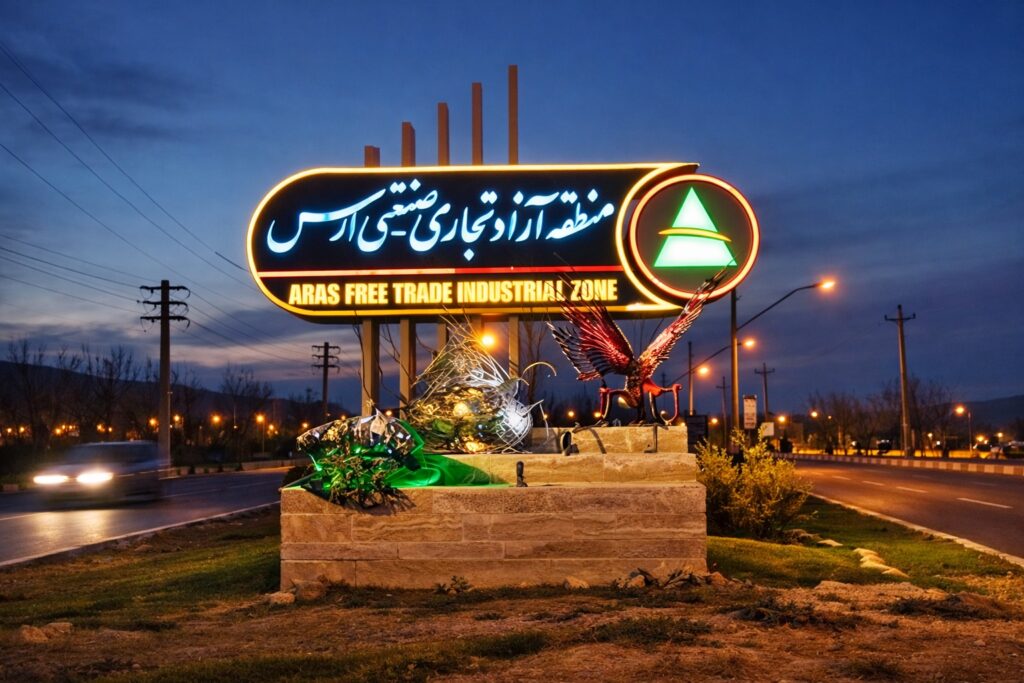
Economic development in developing countries, particularly those governed by rentier and centralized structures, has always faced fundamental challenges regarding the fair distribution of resources and opportunities. Within Iran’s political geography, these challenges transcend conventional economic inequalities, becoming intertwined with complex layers of ethnic discrimination, the securitization of space, and “internal colonialism” approaches. The Aras and Maku Free Trade-Industrial Zones, located in the heart of South Azerbaijan, are stark examples of the contradiction between the regime’s development-oriented slogans and the exploitative, controlling realities on the ground. Utilizing theoretical frameworks from political economy and the sociology of development, this analytical report seeks to deeply examine the failure of these two regions in achieving sustainable development goals and the reasons they have transformed into tools for reproducing central dominance over the periphery.
Theoretical Foundations: Rentier State, Internal Colonialism, and the Center-Periphery Divide
To understand the nature of free zones in Iran, one must first address the “Rentier State” structure. First proposed by Iranian economist Hossein Mahdavi in 1970, the concept of the rentier state describes states that derive a large portion of their income from external sources (such as oil and gas sales) rather than domestic taxes. In such a structure, the state, instead of being a structure responsible to its citizens as a product of a social contract, becomes a “rent distributor” that uses national wealth to strengthen the loyalty of interest groups and consolidate its own power.
Evidence shows a direct relationship between oil revenues and gross fixed capital formation during the Pahlavi era and subsequently under the Islamic Republic; however, after the 1973 oil shock, this relationship in Iran evolved into a direction where oil rents were spent on political consumption expenditures and non-productive activities instead of productive capital accumulation. This rentier model merged with “oil populism” during Mahmoud Ahmadinejad’s presidency. During this period, massive oil revenues were spent on cash subsidies and ostentatious projects like “Mehr Housing”; while this gained support from low-income groups in the short term, it caused unbridled inflation, the destruction of institutional infrastructure, and increased structural poverty in peripheral regions in the long run.
In addition to rentierism, the theory of “Internal Colonialism” provides a precise tool for analyzing the situation in South Azerbaijan. According to Pablo Gonzalez Casanova’s definition, internal colonialism occurs when, once direct foreign dominance is eliminated, the exploitation of locals by other locals (the ruling elite at the center) takes its place. In Iran, this process is implemented through a nationalism centered on the Persian language and the Shiite sect, marginalizing non-core nations such as Azerbaijani Turks, Kurds, and Balochis.
Internal colonialism in Iran is not limited to linguistic and cultural oppression; it manifests itself in the form of “De-development.” In this process, the sovereign power intentionally implements strategies that hinder structural reforms and independent economic development to maintain the peripheral regions’ dependence on the center. As a result of this approach, the periphery turns into a source of raw materials, a reservoir of cheap labor, and a market for central goods, while remaining a “permanent exception” politically and socially, trapped in a security vice.
The center-periphery gap in Iran is a geographical and economic reality produced by macro policies. Studies by the Ministry of Cooperatives, Labour, and Social Welfare for 2021 and 2022 confirm that central provinces like Tehran, Alborz, and Semnan have the lowest deprivation rates, whereas border provinces inhabited by non-Persian nations rank at the bottom of development indicators. This inequality does not stem solely from distance from the capital; it is a reflection of extreme centralization where political power, capital, and high-level services are concentrated at the center, and the periphery is only considered during crises or for resource extraction.
Aras and Maku Free Zones: From Development Slogans to the Reality of Exploitation
Free Trade-Industrial Zones in Iran were established in the late 1360s (late 1980s) to diversify non-oil exports, attract foreign investment, and provide technology transfer. The Aras Free Zone in Jolfa and the Maku Free Zone in northwestern Iran were promoted as locomotives for the development of South Azerbaijan, based on their strategic border positions with Turkey, the Republic of Azerbaijan, and Armenia. However, despite decades passing, the performance of these regions shows a serious deviation from the initial goals.
According to 2025 statistical data, although the Aras Free Zone reported a positive trade balance of $260 million in the first 9 months of the year, a closer inspection reveals that these exports mainly consist of low-value-added goods or re-exports. Claims of a 320% increase in domestic investment in the region do not align with the livelihood realities of the residents of Jolfa and Hadishahr. Analysts point out that instead of being production-oriented poles, free zones in Iran have turned into consumption-good import bottlenecks that uproot local small-scale production. The situation is similar in Maku, the largest free zone in Iran by area. Despite having a 130 km shared border with Turkey and a 140 km border with the Republic of Azerbaijan, this region has failed to become a standard transit hub, and its activities have been heavily affected by political fluctuations and central decisions from Tehran.
Economic Indicators of Selected Free Zones (2024-2025 Data)
| Region | Export (Million $) | Import (Million $) | Trade Balance (Million $) | Employment/Infrastructure Status |
| Maku Free Zone | 169 | 37 | +132 | Road transit and micro-industry focused |
| Aras Free Zone | 180 | 151 | +29 | 320% growth in nominal investment |
| Kish Free Zone | 224 | 119 | +105 | Tourism and financial services oriented |
| Qeshm Free Zone | 257 | 143 | +114 | Energy and bunkering focused |
| Chabahar Free Zone | 5 | 174 | -169 | Severe trade deficit, dependent on imports |
This table shows that the free zones in South Azerbaijan (Aras and Maku) have a better trade balance compared to regions like Chabahar or Anzali. However, this trade surplus stems from their intermediary role in trade with Turkey and the Caucasus rather than a domestic industrial breakthrough. In fact, the profits obtained from these activities are transferred to Tehran through the central banking system, and only a tiny fraction is spent on developing welfare, health, and education infrastructure in South Azerbaijan.
Comparative Analysis: Why Couldn’t Aras and Maku Become “Shenzhen” or “Tanger Med”?
Comparing Iran’s free zones with successful global examples like Morocco’s “Tanger Med” or Turkey’s “Aegean Free Zone” reveals the depth of structural failure in Iran. Morocco’s Tanger Med is currently the second most competitive free zone in the world and is built on five main pillars: strategic location, industrial clustering, targeted incentives, administrative efficiency, and trade facilitation. By attracting automotive giants like Renault, Tanger Med has succeeded in creating a complete industrial ecosystem that generates over 1,000 companies and thousands of high-skilled jobs. In contrast, although the Maku Free Zone possesses similar geographical potential as a bridge between Asia and Europe, it suffers from a lack of expert management and international isolation resulting from sanctions.
In the Turkish model, the Aegean Free Zone (ESBAŞ) is managed by the private sector and focuses on high-tech industries such as aviation and medical devices. By establishing the “Aerospace Clustering Association” and cooperating closely with universities to train a qualified workforce, this zone has become a model of excellence. However, management appointments in Aras and Maku are entirely political and top-down. Managers sent from Tehran lack understanding of the social and economic dynamics of South Azerbaijan and chase short-term, flashy projects instead of creating local industrial clusters. The absence of a true “single-window” system and a centrally corrupt bureaucracy has destroyed the motivation of foreign investors to enter these regions.
Another fundamental difference is the legal system. Successful free zones in the Persian Gulf, such as the Dubai International Financial Centre or the Abu Dhabi Global Market, use a “Common Law” system to attract international investors. In Iran, however, free zone laws are subject to vague and contradictory domestic legal interpretations that minimize investment security due to the influence of security and military institutions.
Securitization and the Influence of the Revolutionary Guard (IRGC): The Main Obstacle to Development
The bitter reality in Iranian political economy is the influence of the Islamic Revolutionary Guard Corps (IRGC), which has permeated all vital veins, including free zones. The IRGC is not just a military force but also Iran’s largest economic employer, holding 20% to 40% of the national economy. In the border regions of South Azerbaijan, this influence doubles under the pretext of “national security.” The Khatam al-Anbiya Construction Headquarters and its affiliated companies seize most of the large construction and infrastructure projects in Aras and Maku without legal procedures or healthy competition.
The presence of the military in the economy has had devastating consequences. First is the suppression of the real private sector; no independent investor can compete with institutions that benefit from tax exemptions, rent information, and judicial immunity. Second is the securitization of the business environment; in Maku and Aras, any economic activity that conflicts with the interests of military institutions is suppressed with security labels and baseless accusations. Reports from UNPO and human rights organizations show that Azerbaijani economic and civil activists seeking transparency in the management of these regions face arbitrary arrests and heavy sentences.
In addition, the IRGC has led the environmental infrastructure of South Azerbaijan to ruin by establishing what is called the “water mafia.” Ill-conceived dam projects and water transfers carried out by IRGC-affiliated companies have led to the drying up of Lake Urmia and the destruction of the region’s agricultural and tourism potential. This process is part of a “de-development” strategy where the region is stripped of its vital resources, residents are forced to migrate to Persian-speaking central regions, and the demographic structure and economic power of Azerbaijan are weakened.
Ethnic Discrimination and Structural Deprivation in South Azerbaijan
The failure of the Aras and Maku free zones cannot be analyzed independently of the systematic discrimination policies toward the Azerbaijani nation. The Iranian state has excluded the Azerbaijani Turkish language from the education and official system by imposing cultural hegemony; yet, according to Iran’s own constitution, the use of local languages should be free. This cultural pressure is directly reflected in the economic sphere, such that native Azerbaijanis are excluded from high-level management positions in free zones, and employment priority is given to those sent from the center or those who have proven absolute loyalty to the ruling ideology.
Studies show that despite the massive potential of the East and West Azerbaijan provinces, they receive a much smaller share of national development budgets compared to central provinces. This “allocative discrimination” has prevented even the free zones from creating a positive spillover effect on the surrounding rural economy and small towns. Poverty in the border regions of Azerbaijan has become so institutionalized that many young people turn to risky activities like kolbari (load carrying) or fuel smuggling out of desperation, while the regime criminalizes this situation to prepare the ground for further oppression.
The “Woman, Life, Freedom” movement has shown in recent years how the economic demands of the periphery are intertwined with identity and gender demands. The brutal suppression of protesters in Tabriz, Urmia, and other cities of South Azerbaijan was a response to a people who object not only to poverty and unemployment but also to the “internal colonialism” structure that views them as second-class citizens.
Geopolitics of Corridors and Tehran’s Fear of Azerbaijani Integration
Geopolitical developments after the 2020 Karabakh War have brought pressures on the Aras and Maku free zones to a new stage. The “Zangezur Corridor” project, which establishes a direct connection between the Republic of Azerbaijan, Nakhchivan, and Turkey, is a strategic nightmare for Tehran. The Iranian administration fears that with the opening of this corridor, Iran’s transit role will vanish and South Azerbaijan will naturally gravitate toward the Baku-Ankara economic pole.
Tehran, from a paranoid perspective, labels the Zangezur Corridor as the “NATO Turan Corridor” and is trying to prevent geopolitical changes by ostensibly strengthening the Aras Free Zone and proposing the “Aras Corridor” project through Iranian territory. However, these efforts are doomed to fail due to the lack of trust between the administration and the local population, as well as ongoing tensions with the Republic of Azerbaijan and Turkey. While Iran wants to profit from regional transit on one hand, it fears any economic growth that would strengthen Azerbaijani nationalism on the other. This internal contradiction has caused Iran’s policies in Aras and Maku to revolve around “control and restriction” rather than development.
Conclusion and Policy Recommendations
This report reveals that the Aras and Maku free zones function not as development engines, but as tools of internal colonialism and mechanisms for the reproduction of rentier state structures. The failure of these regions is not a simple accident or a result of poor management; it is a structural product of a governing logic that views the ethnic periphery as a threat to its own survival. To exit this situation and ensure sustainable development in South Azerbaijan, the South Azerbaijan Center for Strategic Studies (SACSS) offers the following policy recommendations:
First, it is essential to completely decentralize the administrative and financial aspects of the Aras and Maku free zones and transfer their management to the native elites and technocrats of Azerbaijan. The practice of “fly-in” (temporary) management sent from Tehran must end, and decisions should be made according to the actual needs of the region. Second, military and security institutions, particularly the IRGC, must completely withdraw from economic and infrastructure activities in these regions. Financial transparency and free competition are the only ways to attract real investment and prevent structural corruption.
Third, the cultural and linguistic rights of the Azerbaijani nation must be recognized as the foundation of human development. Education in the mother tongue in regional schools and universities, and its use in the official correspondence of free zones, will help strengthen trust between the nation and the state and reduce security costs. Fourth, macro-environmental policies must be reviewed, and the IRGC’s destructive dam projects must be halted to revive Lake Urmia and protect South Azerbaijan’s production potential.
In conclusion, Iran must abandon its security-oriented perspective toward its neighbors, especially Turkey and the Republic of Azerbaijan, and view the Aras and Maku free zones as part of a larger regional supply chain in the Turkic world. Economic integration with neighbors, rather than fearing it, is the only way to save these regions from their current impasse. Without these fundamental reforms, the free zones in South Azerbaijan will remain merely storefronts hiding the bitter realities of discrimination and backwardness.