Dr. Derya Chetinkaya
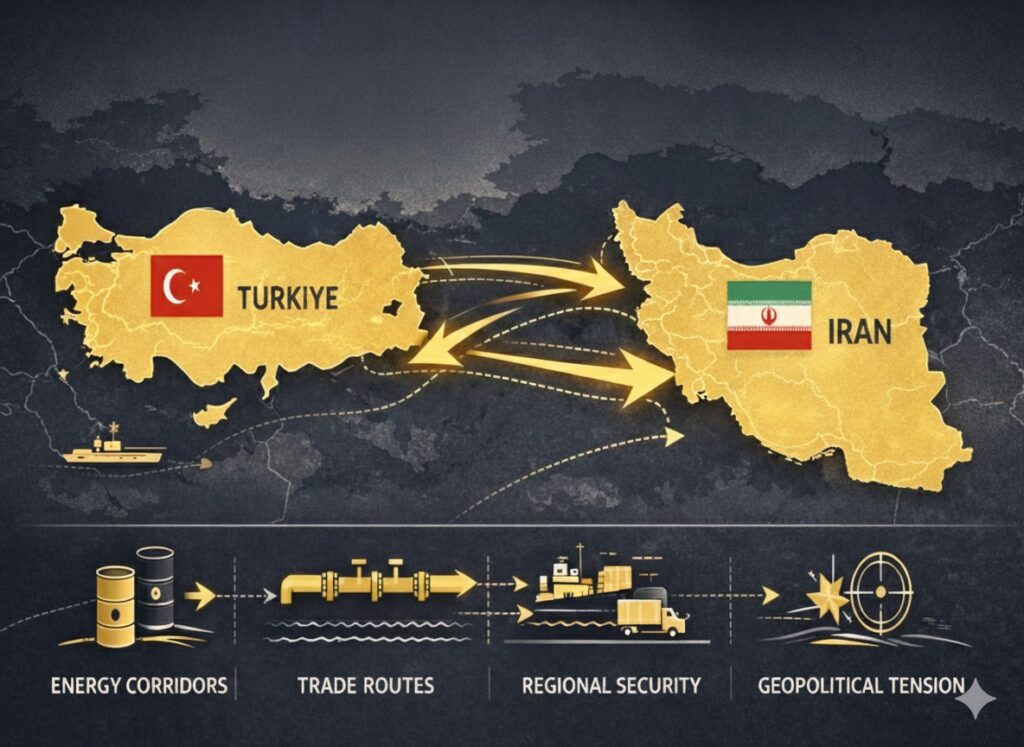
The two-year period of 2025 and 2026 has been recorded as a decisive juncture in the history of Middle Eastern diplomacy, during which the regional order was redefined under the influence of surgical military interventions and the return of maximum pressure doctrines. In this context, relations between Iran and Turkey have shifted from a traditional managed rivalry towards a form of “threshold management”; where Ankara views Tehran’s stability not as a diplomatic choice, but as a pillar of its own national security. The developments of this period, especially after the large-scale military attack by the United States and Israel on Iran’s nuclear facilities in June 2025, dubbed “Operation Rising Lion,” altered the balance of power unprecedentedly in favor of Turkey. The fall of the Assad regime in Syria in late 2024 and early 2025 also dealt a structural blow to the “Axis of Resistance,” severely reducing Iran’s regional influence, while consolidating Turkey as the new hegemonic actor in the Levant and northern Iraq.
Redefining the Balance of Power After the Geopolitical Earthquakes of 2025
The year 2025 began with a strategic rupture. Donald Trump’s direct letter to Iran’s leadership in March 2025, setting a 60-day deadline to reach a new nuclear deal, ushered in a new phase of confrontation. When initial talks in Muscat and Rome hit an impasse over fundamental disagreements on zero enrichment and extensive inspections, the US and Israel executed a series of precision strikes against Iran’s nuclear and military infrastructure in June 2025. This intervention, also referred to as “Operation Midnight Hammer,” while not leading to regime change, crippled Iran’s strategic capabilities for months and severely inflamed the security environment around Turkey.
Structural changes in the balance of power during this period have been profound; Iran’s regional influence in Syria, which was extensive in 2024, was replaced in 2026 by the complete elimination of official and physical presence, leading to absolute Turkish dominance in the Levant. From a nuclear perspective, Iran’s breakout time, estimated at 2-4 weeks before the crisis, increased to an estimated 6-12 months in 2026, severely reducing Tehran’s leverage in negotiations. Furthermore, Iran’s internal stability situation transformed from sporadic protests in 2024 to a legitimacy crisis and nationwide protests in 2026, doubling Turkey’s fear of a migration wave. Finally, the collapse of purchasing power in Iran, with the gold price in the Tehran market surging past $5,000 in February 2026, has posed a serious challenge to the commercial economy between the two countries.
The Fall of the Assad Regime and the Collapse of Iran’s Land Corridor
One direct consequence of the weakening central power in Iran was the rapid collapse of Bashar al-Assad’s regime in Syria. Iran, which had spent over $30 billion to sustain this regime, lost its vital access to the Mediterranean Sea and supply lines to Lebanese Hezbollah with the fall of Damascus in late 2024. This power vacuum was immediately filled by Turkish-backed forces. The new government in Damascus, with a Sunni identity and strong orientation towards Ankara, not only marginalized Iran’s influence but also began cutting Tehran’s military ties with non-state actors in the region. For Turkey, this development meant victory in a 14-year rivalry, but simultaneously created concerns about potential suicide reactions from remaining pro-Iranian cells.
Although Iranian officials emphasize the rapid rebuilding of damaged facilities, technical reports indicate that the destruction of advanced centrifuges and missile guidance systems has increased Iran’s nuclear breakout time from a few weeks to several months. However, Iran still possesses approximately 407 to 420 kilograms of 60% enriched uranium, posing a potential threat of returning to a “threshold” status. This gray situation places Turkey in a difficult position; Ankara welcomes the weakening of Iran’s regional influence on one hand, but on the other, fears the outbreak of an all-out war that would lead to the complete collapse of the state structure in Tehran.
The United States’ Strategy Towards Iran: From Military Pressure to Personal Diplomacy
In 2026, the Trump doctrine towards Iran reached its peak of complexity. The US organized its largest air and naval deployment in the Middle East since the 2003 invasion of Iraq. The simultaneous presence of multiple aircraft carriers sent a clear signal of readiness for a prolonged war to Tehran. In February 2026, the USS Gerald R. Ford was stationed off the Mediterranean coast near Israel for naval control and long-range strikes, while the USS Abraham Lincoln was positioned in the Arabian Sea and Oman to direct air operations against targets inside Iran. Simultaneously, B-52 and B-21 bombers were placed on standby at bases in Diego Garcia and the US to destroy underground facilities, and THAAD systems in Gulf countries were activated and strengthened for defense against possible Iranian missile retaliation.
The deployment of US forces was not limited to naval assets; the stationing of F-35A fighters in Jordan and numerous tanker aircraft at regional bases indicated planning for weeks-long air operations against strategic targets deep inside Iranian territory. In February 2026, tensions peaked with a US F-35 shooting down an Iranian Shahed-139 drone near the USS Lincoln and IRGC attempts to seize oil tankers in the Strait of Hormuz.
2026 Nuclear Talks: From Muscat to Geneva
Unlike in 2025, the 2026 talks began under the shadow of Iran’s extreme economic weakness. The collapse of the rial and runaway inflation forced Tehran to send Ali Larijani with broad negotiating authority. In this round of talks, mediated by Oman in Geneva and Muscat in February 2026, the US put forward demands beyond the nuclear issue, including restrictions on the missile program and a complete halt to support for remaining proxy groups. Turkey attempted to play its “bridge” role by hosting talks in Istanbul, but Iran’s insistence on moving the talks to Muscat in February 2026 revealed underlying tensions between Tehran and Ankara over regional issues.
The Erdoğan government took its “threshold management” policy to its peak in 2026. Recep Tayyip Erdoğan consistently warned that a war against Iran would only lead to “regional destabilization and the strengthening of terrorist groups.” Turkey presented itself as the only actor capable of simultaneously dialoguing with both Trump and Pezeshkian. Foreign Minister Hakan Fidan, through frequent trips between Washington and Tehran, tried to propose a formula for “limited and controlled enrichment” to prevent the US from delivering a second military strike.
Turkey’s great fear is not Iran becoming a nuclear power, but rather the “Syrianization” of Iran. Analysts in Ankara believe that any collapse of the power structure in Tehran would create a massive security vacuum on Turkey’s eastern borders, immediately to be filled by the PKK and its Iranian branch, PJAK. Devlet Bahçeli, leader of the MHP, in his speeches in January 2026, compared the Iranian protests to the “Gezi Park” model, calling it an imperialist plot to divide regional countries.
Given Turkey’s hosting of over 3.6 million Syrian refugees, the potential for a new wave of asylum seekers from Iran (with a population of 93 million) is viewed as an “existential threat” to Turkey’s social fabric and economic stability. According to intelligence reports, Turkey significantly increased the construction of border walls and use of electronic surveillance technologies in early 2026, and even envisioned plans for creating a “safe zone” inside Iranian territory for the possible安置 of displaced persons in case of war.
Competition over Economic Corridors and Energy Geopolitics
The year 2026 is a turning point in the energy relations of the two countries. Iran’s 25-year natural gas export agreement with Turkey expires in July 2026. This comes at a time when Turkey is under intense pressure from Washington to reduce dependence on Iranian and Russian energy. Ankara currently faces four strategic options: fully renewing the contract at a lower price (providing cheap energy but carrying the risk of violating US sanctions); converting the contract into a “swing supply” agreement to increase diplomatic maneuverability (potentially causing severe Tehran dissatisfaction); completely replacing it with US LNG, ensuring closeness to Washington but increasing heating costs in eastern Anatolia; and finally, a short-term 1-2 year extension to buy time until the outcome of nuclear talks is clear (which perpetuates uncertainty in energy planning).
Ankara strengthened its infrastructure for importing liquefied natural gas from the US by signing long-term agreements with ExxonMobil and Shell in 2025 and 2026. This strategic shift means that Iranian gas is no longer as vital for Turkey’s energy security as it was in the past decade. In the 2026 contract renewal negotiations, Turkey seeks price reduction and increased flexibility (removal of the “take-or-pay” clause); while Iran, under sanctions, desperately needs the foreign currency from this export.
In the South Caucasus, the Iran-Turkey rivalry reached the stage of diplomatic confrontation in 2026. Trump’s support for the “Trump Route for International Peace and Prosperity” (TRIPP), or the Zangezur Corridor, has placed Iran in a geopolitical deadlock. This corridor, intended to connect Azerbaijan to Nakhchivan and Turkey via Armenia’s Syunik region, threatens Iran’s land border with Armenia. Iran sees this project as a “NATO-Zionist” plan to cut its access to Europe and create a geopolitical encirclement. In contrast, Turkey views it as the heart of the “Middle Corridor” and a means for direct connection to the Turkic world in Central Asia.
One neglected but vital dimension of bilateral relations in 2026 is water tension. Iran faces an absolute water scarcity crisis (less than 850 cubic meters per person) and considers Turkey’s dam projects on the headwaters of the Aras River as the main cause of the drying of its northwestern plains. In late 2025, Turkey and Iraq signed new frameworks for water management and data sharing, from which Iran was deliberately excluded. This isolation in the hydrophilical sphere worries Tehran that Turkey is seeking to use water as a tool of political pressure alongside economic and military tools. Iranian officials have warned that reduced flow of the Aras River could lead to mass forced migrations from East Azerbaijan and Ardabil provinces, which would themselves be a source of new instability.
Role of Extra-Regional Actors: China and Russia in the Tehran-Ankara Rivalry
While the US increased military pressure, China and Russia tried to prevent the complete collapse of Iran in 2026, though their interests do not always align with Tehran’s. China, which purchased over 80% of Iran’s oil in 2025, began pressuring Washington in February 2026 to accept “limited enrichment” so that the energy flow eastward would not be disrupted. The joint naval drill by Iran, China, and Russia in the Strait of Hormuz in February 2026, coinciding with the Geneva talks, indicated the formation of a kind of “diplomatic resistance bloc.” However, Russia on the Zangezur Corridor issue showed it is willing to ignore Iran’s interests to get closer to Turkey and Azerbaijan, a matter that led to open disagreements between Tehran and Moscow in late 2025.
Scenarios for the Second Half of 2026
According to available data, Iran-Turkey relations in the remaining months of 2026 will be influenced by three main variables: the fate of the Trump nuclear talks, the physical progress of the Zangezur Corridor, and Iran’s internal stability situation.
Scenario One: Limited Agreement and Cold Stability
In this scenario, Iran, under crushing economic pressure and military threat, agrees to an interim agreement (“less for less”). Turkey would play the role of guarantor of the agreement and financial transit hub in this case. This scenario is considered the most likely option because no party, including Turkey, is prepared for the costs of an all-out war.
Scenario Two: Surgical Military Strike and Turkish Border Intervention
If talks hit an impasse in March 2026, the likelihood of extensive US missile strikes on Iran’s vital (not just nuclear) infrastructure increases. In this case, Turkey might be forced into military intervention in border areas to create a “buffer zone” and prevent PKK infiltration. This situation would push bilateral relations towards open hostility.
Scenario Three: Iran’s Strategic Turn to the East and Hydro-political Isolation
If Iran withdraws from talks and moves towards creating a completely closed economy with Chinese support, Turkey will move towards completely cutting energy dependence on Iran and completing the Zangezur Corridor. In this scenario, Iran becomes a “geopolitical island” whose northern and western borders are controlled by the Ankara-Baku-Tel Aviv axis.
Strategic Perspective
In-depth analysis of the 2025 and 2026 developments shows that Iran-Turkey relations have shifted from a “rivalry between two equal powers” to a state of “interaction between a rising regional power (Turkey) and a contracting power (Iran).” Turkey has skillfully used US pressure on Iran to advance its goals in Syria, Iraq, and the Caucasus, without completely destroying its communication bridges with Tehran.
For Iran, 2026 is a year of “difficult choices.” Tehran can no longer challenge Turkey by relying on its strategic depth in Syria or its energy leverage. In contrast, Turkey must be careful that excessive pressure on Iran does not lead to an “internal explosion” in that country; because the shrapnel from such an explosion would directly target Turkey’s national security, economy, and social fabric. Ultimately, the stability of relations between these two neighbors in 2026 is based not on trust, but on “mutual fear of chaos.”