Meisam Kahveci
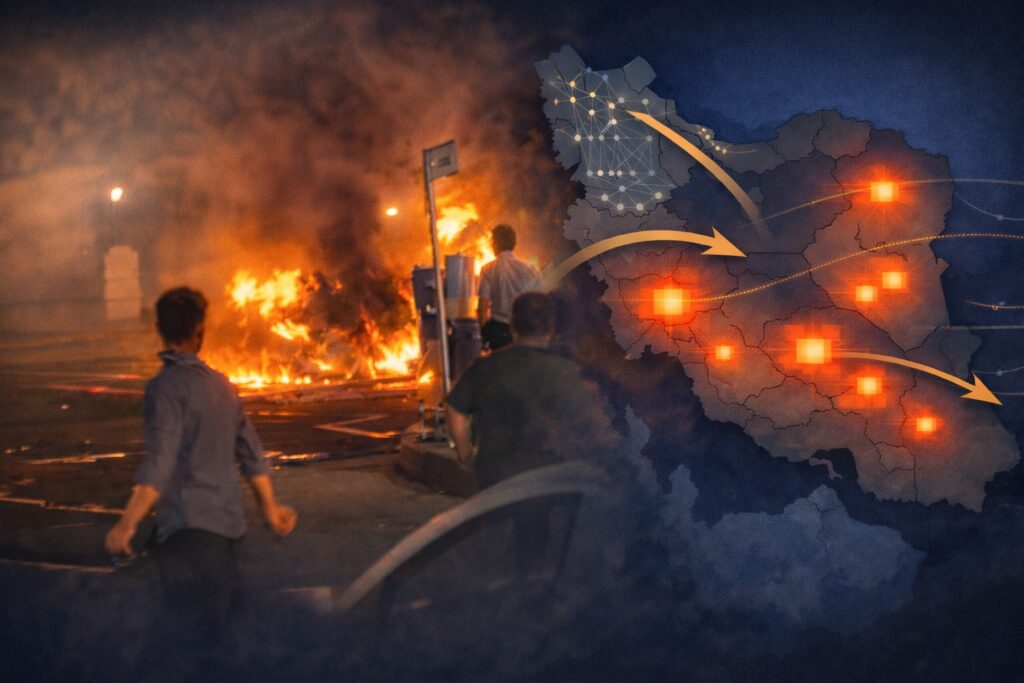
Why has Iranian Azerbaijan shown a low presence in recent nationwide protest movements, or essentially preferred silence and tranquility? This question becomes even more pronounced given the region’s minimal participation in major socio-political events that occurred in 2009, 2017, 2019, 2022, and 2025-26. Although this past December, for two days, some cities in the region, such as Ardabil experienced similar mobilizations as seen in other parts of the country, the protests in Azerbaijan’s provinces and the number of martyrs remained significantly lower compared to other regions. This situation becomes even more complex when we know that Azerbaijan, like other peripheral regions of the country, suffers additional pain from the adverse consequences of centralism and the center’s unjust policies, alongside the usual oppressions.
The relative silence or limited participation of Iranian Azerbaijan in nationwide protest waves over the past two decades, despite the existence of chronic discontent against centralist and discriminatory policies, poses a fundamental question for social and political analysts. How does a region with a history of playing an influential role in contemporary Iran’s transformations, including the Constitutional Movement, the Democratic Party events, the oil nationalization movement, and the 1979 Revolution not find itself at the center of nationwide protests today? Is this “silence” the result of a historical disillusionment stemming from the gains of previous revolutions, or a reflection of a new reckoning with power relations? Is it possible to propose the following hypothesis: Have ethno-cultural demands and discontent with structural discrimination in Azerbaijan remained so deep and unresolved that they essentially overshadow nationwide protests of an “economic” or “civil” nature? In other words, have identity-based and ethnic demands superseded class-based and national demands?
What is it that turns Azerbaijan into a “pressure relief valve,” disrupting the country’s equilibrium from a kind of convergence? Has the experience of the brutal suppression of ethnic and identity-based protests in past decades led to a form of “political learning” that results in avoiding costly confrontations with the state center? In other words, can the current “tranquility” be seen as the outcome of a cost-benefit calculation in light of collective memories of state violence? If Azerbaijan suffers from the additional oppression of centralism, why does this pain not transform into collective protest action on a national scale? Does this phenomenon point to a deeper crisis in “national solidarity” and a discursive disconnect between regional demands and national aspirations?
To provide a brief explanation for the above questions: Azerbaijan is a bodiless soul. By “soul,” I mean a perspective, a historical mentality, collective memory, and a type of subjectivity; by “body,” I mean the concrete network of institutions, political organization, structures of representation, established leaderships, and institutionalized means for the expression and implementation of collective will. Clearly, a bodiless soul cannot manifest effective presence in the social world; nor is Azerbaijan a wandering or entirely bodiless soul. Interconnected geography, shared historical experience, language, cultural memory, economic ties, and similar lived experiences provide this soul with a minimal body. It is these elements that make possible the recognition of the collective “we” and allow for the formation of a sense of belonging and shared destiny.
However, the issue lies in the relationship between this soul and body: It is as if, on one hand, this soul has not yet attained historical and political self-awareness, unable to express itself as a clear discourse and enlightened project; on the other hand, its body is not so institutionalized and integrated as to embody this mentality in sustained and organized action. The result is the formation of a distance between “feeling” and “expression,” between “perception” and “action.” The mentality seems to exist, but its institutional translation is weak; the desire seems present, but the mechanism for its realization is unclear.
The absence of organization, structure, a specific powerful and influential individual or movement—or the lack of any element currently assuming such a role—prevents the representation, shaping, and direction of this mentality, thus making it impossible for the soul to transform into a functional body. In such a situation, social energy usually manifests in small, scattered, situational, and sometimes symbolic actions rather than large, focused ones. This fragmentation is not necessarily a sign of the absence of will, but rather an indication of the absence of a vessel that can hold, concentrate, and transform that will into visible power.
From this perspective, silence or low voice does not necessarily imply consent or passivity; perhaps it is a kind of “suspension” (the suspension between the desire to express and the absence of means of expression). Such a state resembles a situation where collective consciousness has formed but has not yet found its institutional language. It is here that the metaphor of the “bodiless soul” gains meaning: an entity that is felt, leaves an impact, inspires, and reacts at critical moments; yet, due to the absence of an organized body, it cannot remain continuously and systematically on the stage.
Ultimately, the core issue is not the absence of mentality or desire, but the matter of “mediators”: mediators capable of transforming historical experience into a political program, a sense of identity into a public demand, and collective memory into collective action. Until these mediators are formed, the soul will remain, in the grand equations, not as an embodied and determining force, but rather as a sign, an echo, or the shadow of a possibility of existence.
The Dialectic of the Present Moment
If we consider the present moment not as a disconnected instant, but as a link in the chain of time, it is always the heir to the past; and the past persists in the present not merely as memory, but as patterns of perception, habits of action, and mental formations. From this perspective, the “present moment” is not a singular state, but a knot where many threads of history converge. Dialectical reading begins precisely here: from understanding the present moment as the product of tensions, accumulations, defeats, hopes, and repeated redefinitions. Such a reading aims to show that what appears today as silence, caution, or a specific pattern of action is not accidental or merely reactive, but the result of a historical and structural path.
Within this framework, it must be emphasized once again that in this discussion, “Azerbaijan” is not merely a geographical name or the arithmetic sum of individuals. The aim is not a statistical or demographic totality either; it is the product of a mentality. This mentality manifests itself in observable behaviors, in modes of speech, in preferences, choices, and collective or semi-collective decisions. It can be imagined as an invisible logic; it casts a shadow over actions. This logic is not necessarily conscious or planned, but reveals itself in the repetition of similar patterns. In other words, the subject of analysis is not the actions themselves, but the “hidden rule” behind the actions.
Examples of this mental representation can be seen in common expressions: “Azerbaijan is a tractor” (referring to the popular Tractor Sazi Tabriz football club), “Azerbaijan pursues its own interest,” “Azerbaijan exhibits different political behavior,” “Azerbaijan was behind Pezeshkian,” and the like. The importance of these sentences lies not in their statistical accuracy, but in their signifying function. They are narratives—even if exaggerated or simplistic—that point to a specific pattern of behavior in collective perception. Such expressions should be read as linguistic signs of a deeper truth: the fact of the existence of a different mentality; a mentality that manifests itself at critical moments in the form of coherent choices or simultaneous non-participation. For example, the relative convergence in some political elections or the common abstention from certain protest events, value judgments aside, could be an indication of the functioning of this inner logic.
Of course, one could object to these expressions based on individual differences, saying “Not all Azerbaijanis are tractors” or “Not everyone stood behind the same political choice.” This objection is statistically valid but misses the main point of the argument. The issue here is not empirical generalization, but theoretical formulation. Theoretical analysis aims to discover tendencies, patterns, and structures of meaning, not to count exceptions. Just as speaking of “class,” “generation,” or “discourse” in the social sciences does not mean homogenizing everyone, speaking of an “Azerbaijani mentality” points to a dominant tendency at the level of discernible patterns, not an absolute judgment about individuals.
Therefore, it is possible to understand Azerbaijan as a “position”: a historical position that has traversed a complex, winding, and multi-layered path from the past to the present. This position is the product of the collision of various forces—center-periphery, cultural-political, economic-identity-based—and at each stage, it has taken new form from these collisions. In this view, today’s present moment is not merely the final stop on the path, but a phase in a continuous dialectical process; every new situation is both a continuation of and a reaction to the past, both its product and its critique.
In the next section, this dialectical path—that is, the transition from historical experiences to today’s mental formation—will be reconstructed narratively and analytically; a narrative showing how different layers of the past have intertwined to create the situation we encounter today.
Passivity
It must be remembered that history is a chain, and our starting point is not the year 2009-10; there have been many ups and downs and intertwined transformations. We began here selectively to illustrate the dialectical present. The summary of the state of passivity is this: Azerbaijan does not participate in protests. When protests over the Iranian election results engulfed the country in 2009-10, Azerbaijan did not take part in these protests on a large scale; yet it was one of the regions where a broad movement had occurred before the election. In fact, it was one of the regions that gave the most votes to Mir-Hossein Mousavi. In 2017, 2019, and 2022, the situation was approximately the same; the Turks of the region generally preferred silence and tranquility.
The question is: Why do factors such as high prices, objections to election results, the hijab issue, or other factors that spark protests in other regions, not lead to significant protest here? Other questions can also be asked: Is Azerbaijan distrustful of the centralist position of both the Iranian government and the opposition? Does it not see its own interests within these centralist movements?
If we view dialectics not merely as a philosophical method but as a way of understanding the movement of history, we must understand every situation in relation to the moment before and after. Within this horizon, “passivity” is not absolute stagnation, but the first link in the chain without which no transition or transformation is possible. In this sense, passivity is not the absence of movement; it is the compressed, concentrated, and accumulated state of forces—the stage where history holds its breath, waiting to release it at another moment. Therefore, passivity must be understood as a historical form, not as a flaw or deficiency.
With such a view, when we speak of Azerbaijan’s passivity, we do not mean absolute immobility, but a threshold state; a situation where social forces have not yet transformed into overt action but are accumulating in the lower layers. This state can be imagined as the “preface” stage in the text of history: the main narrative has not yet begun, but all its elements are forming. For this reason, here passivity is not the end of movement, but the beginning of the logic of movement—the point where dialectics begins.
From a dialectical perspective, every passivity simultaneously possesses two characteristics: first, it is a reflection of the past; second, it is a possibility for the future. Passivity always preserves something—a historical memory, a collective experience, or a learned caution—and at the same time, postpones something else. Therefore, it is possible to see passivity as a form of historical “suspension”: the suspension between wanting and doing, between consciousness and expression, between possibility and realization. In such a state, society neither acts nor is inactive; it is weighing its forces, comparing them, and reorganizing them.
The key point is that passivity, contrary to its appearance, is a completely active state on an internal level. If we consider action as the external manifestation of power, then passivity is the stage of that power’s concentration. Just as the silence before speech is part of speech itself, passivity is part of the historical movement itself. In this sense, visible immobility can be a sign of internal concentration; a sign that forces are not yet organized in a directed manner, but have not disappeared. Dialectics takes shape precisely in this distance between “being power” and “the manifestation of power.”
Proceeding from this view, passivity is neither a sign of consent, nor submission, nor indifference. These are superficial interpretations that confuse passivity with absence. However, in a dialectical reading, passivity is a special form of existence: an existence that has not yet turned into speech, an existence that has not yet found language, a will that has not yet taken external form. Passivity, in this sense, is the stage of “pre-subjectivity”—the stage where the subject is gathering its elements.
If we relate this form to time, we can say that passivity is the moment when the past outweighs the present relative to the present. Historical memory plays a decisive role in such a situation; previous experiences, defeats, unmet hopes, and lost possibilities shape the rhythm of reaction. Consequently, the present moment, instead of turning into action immediately, passes through the filter of the past. This passage is what constitutes passivity: the distance between stimulus and response, between event and reaction.
Therefore, if we see dialectics as a transition from the initial state to the realized state, we must consider passivity as the starting moment of this path—the moment when history reflects upon itself. This moment, though outwardly silent, is inwardly full of dialogue: dialogue between past and present, between experience and possibility, between memory and horizon. Passivity, in this sense, is not history’s silence, but its murmur; a murmur that, if unheard, will never turn into a scream.
Action
Azerbaijan’s political and social life, viewed through a dialectical horizon, is not a simple extension of previous tranquility, but a form born from accumulated passivity. The specificity of this life indicates the existence of a different agency, a particular mentality, and a specific form of subjectivity; this subjectivity does not appear in classical political patterns and does not confine itself to centralist models. For this reason, it is not possible to evaluate Azerbaijan’s action by conventional measures of political participation. This action manifests itself in the logic of choice, in the style of reaction, and in the mode of collective existence, before being embodied in institutions or slogans.
When it is said that “Azerbaijan acts according to its own interest,” it refers to a situational rationality; a rationality that bases action not on momentary excitement, but on historical and social assessment. From the outside, this rationality may appear as caution or distance, but on an internal level, it is an indication of a self-awareness that chooses among possibilities. Here, action is not necessarily a scream; sometimes it is a choice, sometimes a refusal, sometimes a meaningful silence, and sometimes a presence in arenas that others deem non-political—yet which actually carry deep social meaning.
The manifestations of this “act” can be seen in various layers of collective life: in cultural life that reproduces language, music, and historical narrative; in lifestyles that preserve collective memory; in Ashik literature and poetry that transform historical experience into aesthetic expression; in social reactions against cultural humiliation; even in everyday behaviors that carry identity markers. All of these are forms of action, but they operate more at the symbolic and cultural level, and are therefore less visible in conventional frameworks of political analysis.
Beneath the seemingly passive layer, a soft and continuous resistance flows; this resistance manifests itself not in the form of direct opposition, but in the form of preserving meaning, reproducing identity, and redefining position. If there were absolute passivity, society would fall into lethargy, whereas signs of inner vitality are evident in various fields. This internal dynamism shows that apparent tranquility is a cover for deeper movements. In such a situation, action does not operate explosively, but in an accretional manner: slow, continuous, and enduring.
Meanwhile, some social phenomena assume a special symbolic role and act as mediators between mentality and action. The most striking example is the “Tractor” phenomenon; reducing it to a sports club or collective entertainment would be to ignore its layers of meaning. Its persistent and widespread presence in the streets, homes, celebrations, and even daily language indicates that we are not dealing merely with a sporting symbol, but with a particular formation of collective self-expression. This meaning is also reflected in the fans’ anthems and murmurs: “Tractor is neither ball nor goal, neither right nor left / It is a book, an understanding, a path”
This verse interprets the nature of the phenomenon from within: the transformation of an outwardly sporting symbol into a metaphor for consciousness, path, and understanding. Such a transformation of meaning is only possible when a symbol carries the identity-related and experiential burden of a society. For this reason, it is possible to see Tractor as one of the forms through which collective action emerges, an action that reveals itself not in the form of a political organization, but in the form of shared experience and symbolic life.
From the same perspective, social participations and even political elections should also be analyzed within this specific logic. It is not possible to attribute differences in participation patterns solely to error, deception, or chance; they must be seen as an indication of a difference in the apparatus of mentality and assessment. Here, action is the result of an internal weighing—society chooses, among possible options, the one most compatible with its historical and perceptual logic.
Other manifestations of this mentality can be seen in artistic and cultural fields: in the re-creation of historical narratives on stage, in the revival of musical traditions, in publishing and writing movements, in every arena where collective memory finds expression. These fields show that society is not silent, but is speaking—albeit in a language that is not the language of official politics. Such action could be called “deep-structure action”: action based on gradual transformation rather than sudden change.
At this stage—which we might call the moment of temporary synthesis—what happens is the birth of action from passivity. Passivity, previously understood as the accumulation of force, now brings a part of itself to the surface and shows that tranquility was merely the visible form. Action does not come from outside, but is born from within that same tranquility; it is as if passivity has become the womb for the birth of action. In this sense, passivity and action are not opposites, but two moments of a single process: the first moment is accumulation; the second moment is emergence.
Thus, Azerbaijan’s action should be seen as the moment when the previously compressed soul reveals signs of its existence—not necessarily through a scream, but through continuity. Because in dialectical logic, whatever is alive—no matter how calm—will sooner or later manifest itself.
Synthesis: The Bodiless Soul
Ultimately, Azerbaijan’s passivity and activity transform into an agentless act; an act that is clear and effective, yet not directed by any organization, person, or movement. This is the moment when the region’s soul—the collective and diffuse soul—manifests itself through its actions; these actions are not imposed from outside. Azerbaijan is seen through its behaviors, experiences, and existence; it speaks through its acts, touches the world, and creates meaning. Activists cannot set it in motion, but they benefit from its presence and influence; like a soul that gives life to other bodies.
This soul sometimes manifests itself in protests, sometimes on the theater and art stage, sometimes in elections and social processes, sometimes in the Iranian center, sometimes in Urmia and other points of Azerbaijan. Neither the center nor the opposition can claim ownership of this soul; they sometimes try to appear close to it by using its language, symbols, or methods, but the soul remains free and independent.
Being agentless is not irresponsibility. This situation indicates that no organization or individual exists as a definite leader in Azerbaijan; however, as stated in the “Action” section, the people of the region keep this soul alive and give it meaning through their mentalities, experiences, and historical-social behaviors.
The Azerbaijani soul has not yet attained full self-awareness to display itself in a single, complete body. It has not fully seen itself as a social position. A clue to this situation lies in the dichotomy between the idea of independence and the idea of reform: one segment believes that Azerbaijan needs an independent and separate body from Iran, while others think that Azerbaijan still exists as part of Iran and must find its way through fundamental reforms, the abolition of centralism, and partial changes.
The Azerbaijani people are not yet fully aligned with any structure, and full consciousness has not formed—but this does not mean an absence of consciousness. The bodiless Azerbaijani soul still needs to think, deepen, and attain self-awareness; this process, at the elite level in the past, gained temporary and intermittent manifestations in state and social forms, but never transformed into a permanent and integrated structure.
This bodiless soul, as a stage of dialectical synthesis, both preserves experience and history and is the potential ground for future actions; the place where past and present merge, preparing the possibility for the birth of a more complete and self-aware collective identity. This indicates that synthesis is not merely the combination of passivity and activity, but the birth and reproduction of self-awareness from these two; a process still unfinished and awaiting completion.
Conclusion and Addendum
I do not believe that social situations can be completely and definitively shaped by pre-designed engineering and planning. Human society, especially in regions like Azerbaijan with multi-layered history and complexities, is under the influence of many cultural, historical, and social factors; it is not possible to set them in motion solely by command or policy. Nevertheless, awareness of the current situation and recognition of its dynamics can illuminate the path of thought and action and provide the possibility for wise action.
Azerbaijan’s interests and Iran’s general interests are neither completely aligned nor completely separate. This situation leaves Azerbaijan at a point between participation and distance. In practice, this means that every action or passivity emanating from the region takes shape not as absolute acceptance or absolute opposition to the country as a whole, but in a relative and situational manner.
One of the important axes in this regard is the Kurdish issue and their place in Iranian national discourse. Ethnic nationalism and essentialist approaches to history are among the dominant discourses in the country, and they have left their effects in Azerbaijan as well. These effects both enable the formation of ethnicist discourses and create a ground for critique and different reactions. Therefore, conscious reaction or critique of this process is a serious intellectual matter that can help determine Azerbaijan’s identity and social path.
The key point is that the Azerbaijani soul is independent and, at the same time, singular. This soul possesses a specific and independent identity; it manifests itself and carries this identity in every path and condition. Even lacking organization, structure, or specific leadership, it continues to maintain the continuity of identity and social impact through its scattered experiences, actions, and consciousnesses.
After the December events and those two days, this bodiless soul faced a fundamental question: What is Azerbaijan’s task? The answer to this question will take shape not from outside, but from within Azerbaijan and through dialogue between elites and the people. This process requires the creation of serious platforms for dialogue, historical and social analysis, and the exercise of collective self-awareness.
The path ahead: Dialogue and alliance. For the realization of this self-awareness, the effort for dialogue among elites and between elites and the people is essential. These dialogues can help clarify Azerbaijan’s identity, interests, and role within Iran. At the same time, alliance with forces outside Azerbaijan capable of forming alliances, and active participation in the ongoing national dialogue, can prepare the ground for influencing the future destiny of Iran and the region.
In conclusion, although the Azerbaijani soul is bodiless at the level of structure and leadership, through thoughtful and intelligent engagement it can consolidate its social and historical existence and move from scattered passivity and activity towards a meaningful collective action with an independent identity. This synthesis would not only ensure the continuity of regional identity, but could also lead to the establishment of a wise balance between regional interests and national interests; thus preserving both mental and cultural independence and possessing meaningful agency within the framework of contemporary Iran.
Given Iran’s current situation, Azerbaijan occupies a position akin to an antithesis. If stability is the thesis, collapse is the antithesis. The synthesis, in any case, will be a new state of stability that also contains collapse within it. However, the previous thesis was a situation between hyper-centralist nationalism and Kurdish military nationalism. Resolving these difficulties is not easy. What is meant by “resistance” is to preserve existence and maintain strength until synthesis is achieved. Azerbaijan might pay a low cost in the first stage of collapse, but could pay a high cost in a possible subsequent stage, for example in an American scenario. Ascension and reaching a lasting synthesis come through the path of resistance. For this reason, avoiding excitement, cautious and temporary cooperation with anti-violence movements at critical moments, deepening intellectual and cultural activities, and building alliances could be the key indicators of resistance. Through this alliance and resistance, Azerbaijan will not be victimized in the event of collapse, will pay a lower cost, and will enter the synthesis stage more prepared.