Dr. Hamid Shehanegi
Executive Summary
In 2026, the Islamic Republic of Iran faces a multidimensional and unprecedented crisis threatening the very existence of its political structure. The sudden death of Ali Khamenei on February 28, 2026, during US and Israeli airstrikes, has not only created a power vacuum at the apex of the political pyramid but has also acted as a catalyst for the eruption of long-suppressed economic, social, and ethnic crises. This report provides an in-depth analysis of the succession process, key actors, the economic collapse, and the geopolitical consequences of this development, with a special emphasis on peripheral regions, including South Azerbaijan.
The power structure in Iran, built upon the theory of Velayat-e Faqih and the absolute concentration of authority in the hands of the Supreme Leader, now faces a test it has experienced only once before, in 1989. The fundamental difference between the current transition and that of 1989 is that while the transfer of power in 1989 occurred within a context of consensus among the revolutionary elite, the current transition is taking place amidst a full-scale regional war, rampant hyperinflation, and a nationwide uprising. Evidence indicates that the exchange rate has reached the threshold of 1.5 million rials to the dollar, and food inflation has exceeded 75%. Meanwhile, the role of the Islamic Revolutionary Guard Corps (IRGC) has evolved into a “shadow government” aiming for the complete militarization of power. For the peripheral regions, this transition period presents a strategic opportunity to redefine their relationship with the center, particularly in South Azerbaijan, where the environmental catastrophe of Lake Urmia and the geopolitical equations of new international corridors are shifting centrifugal forces in their favor.
The Crisis of the Power Structure and Managing the Leadership Vacuum
In authoritarian regimes, the transfer of power is often the most vulnerable phase in the regime’s life cycle. With 37 years in power, Ali Khamenei had maintained a delicate balance among parallel institutions. His elimination through an “act of war” upended all long-term planning for a controlled succession. According to Article 111 of the Constitution, a Provisional Leadership Council was formed, comprising President Masoud Pezeshkian, Head of the Judiciary Gholam-Hossein Mohseni-Eje’i, and Guardian Council member Ali Reza Arafi, to manage the country’s affairs and preserve the system’s legal facade. However, real power lies in the hands of Ali Larijani, who was appointed Secretary of the Supreme National Security Council six days before Khamenei’s death to manage emergencies and prevent the collapse of the command chain in the event of potential “decapitation” strikes. Meanwhile, the Assembly of Experts, led by the 92-year-old Mohseni Kermani, bears the responsibility of electing a permanent leader; however, the destruction of its secretariat in Qom during the March 2026 airstrikes has made holding regular sessions impossible.
Actor Analysis and Candidates for the Position of Velayat-e Faqih
In the post-Khamenei environment, three main figures have emerged as candidates for the leadership position. Mojtaba Khamenei, 55, the most influential figure in the Leader’s Office and the primary liaison to the IRGC, has the support of the system’s hardline base but faces a lack of religious legitimacy and public opposition to the dynastic inheritance of power. In contrast, Ali Reza Arafi, 67, the Director of the Qom Seminaries, holds significant influence within the religious bureaucracy but lacks charisma within the military wing; he is presented as a “safe” option for elite consensus. An unexpected phenomenon of this period is Ali Khamenei (the grandson of the regime’s founder), who can potentially bridge the Qom and Najaf seminaries by leveraging the “Khomeini brand” and familial ties to Grand Ayatollah Sistani in Najaf. Unlike his brother Hassan Khomeini, Ali Khamenei is deemed reliable by the system’s hard core and managed to present himself as a potential leader during Khamenei’s funeral ceremony. Alongside these figures, Mohammad Mehdi Mirbagheri represents the radical current; however, his extreme positions make consensus less likely.
The Collapse of the Rial and the Dimensions of the 2026 General Uprising
The leadership transition coincides with an economic collapse, described as “macro-fiscal entropy.” By January 2026, the rial’s exchange rate against the dollar had exceeded the 1.5 million rial threshold, effectively “dollarizing” the economy. The Pezeshkian government’s decision to raise the price of non-subsidized gasoline to 50,000 rials sparked a general conflagration on December 28, 2025, which spread to 210 cities. These protests formed an unprecedented alliance among Tehran’s bazaar merchants, students, and trucker unions, shifting their demands from economic reforms to the complete overthrow of the regime. The regime’s response was a bloody crackdown utilizing wartime weapons, resulting in thousands of deaths; however, desertion rates reaching 14% in border provinces indicate erosion within the armed forces.
The IRGC and the Transition to a Garrison State
In the absence of a strong leader, the IRGC is progressing toward becoming a “security oligarchy.” To maintain control, the institution has deployed its elite “Saberin” and “Fatehin” brigades in the capital to simultaneously manage internal repression and protect nuclear facilities from external attacks. However, the IRGC’s regional strategy (the “axis of resistance”) has been severely damaged. Washington’s addition of over 100 individuals and companies linked to the Quds Force in Iraq to its sanctions list has choked the IRGC’s financial lifelines and reduced Iran’s influence in Baghdad to its lowest point in two decades. This weakening of regional affiliates has forced the IRGC to focus on internal survival and the complete militarization of the political structure.
South Azerbaijan and the Redefinition of the Caucasus Geopolitical Order
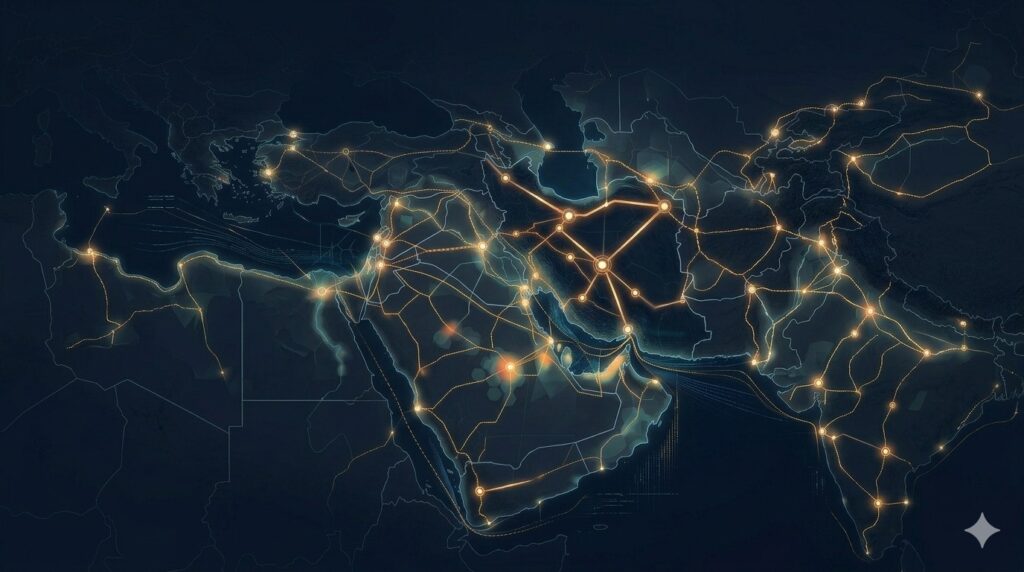
South Azerbaijan has become the focal point of centrifugal developments in 2026. The environmental disaster culminating in the complete drying of Lake Urmia in September 2025 transformed Azeri nationalism into a mass movement against the center’s alleged “environmental racism.” Simultaneously, the signing of the TRIPP Corridor (Trump’s Road for International Peace and Prosperity) agreement in August 2025 altered the equations. This corridor, directly connecting mainland Azerbaijan to Turkey and Europe, eliminated Iran’s leverage over regional transit and energy and played a vital role in marginalizing Tehran. Authorities in Tehran view this project as an “existential threat” capable of strengthening separatist tendencies in the country’s northwest. Similar potential is observed in Kurdistan with the activities of groups like PDKI and in Baluchistan with intensified Jaish ul-Adl attacks, collectively posing a serious threat to Iran’s territorial integrity during the transition period.
Strategic Scenarios and Regional Consequences
Iran’s political future can be envisioned through four main paths: First, controlled continuity, guided by the IRGC, leading to the selection of a leader like Arafi or Ali Khamenei and superficial reforms. Second, an official military coup executed by the IRGC, resulting in the formation of a “nationalist junta” and further international isolation. Third, collapse and fragmentation (Balkanization) similar to the Syrian model, where the central government loses its ability to enforce sovereignty in border regions and ethnic areas move towards independence. Fourth, a democratic transition through the overthrow of the regime by the protesting coalition and the establishment of a provisional government. On the international front, Iran has adopted a strategy of “regionalizing the crisis” to halt pressures, launching missile strikes on US bases and energy facilities in the Persian Gulf. Meanwhile, Russia and China, while condemning the strikes, have refrained from direct military intervention to save the regime, prioritizing the evacuation of their own citizens.
Policy Recommendations and Conclusion
Several key strategies are recommended to manage the consequences of this historic transition: Strengthening the TRIPP Corridor to reduce the region’s transit dependence on Iran; establishing direct communication channels with civil and national elites in peripheral regions (South Azerbaijan, Kurdistan, and Baluchistan) to prevent a power vacuum; and internationalizing the Lake Urmia issue as part of future peace agreements.
The death of Ali Khamenei marks the end of an era of ideological and centralist rule in Iran. The collapse of the rial and the widespread uprisings demonstrate that the structure of Velayat-e Faqih can no longer reproduce itself. Iran’s future depends on whether the new elites recognize the rights of peripheral peoples or whether the insistence on centralism drives the country toward disintegration.