Dr. Hamid Shahanaghi
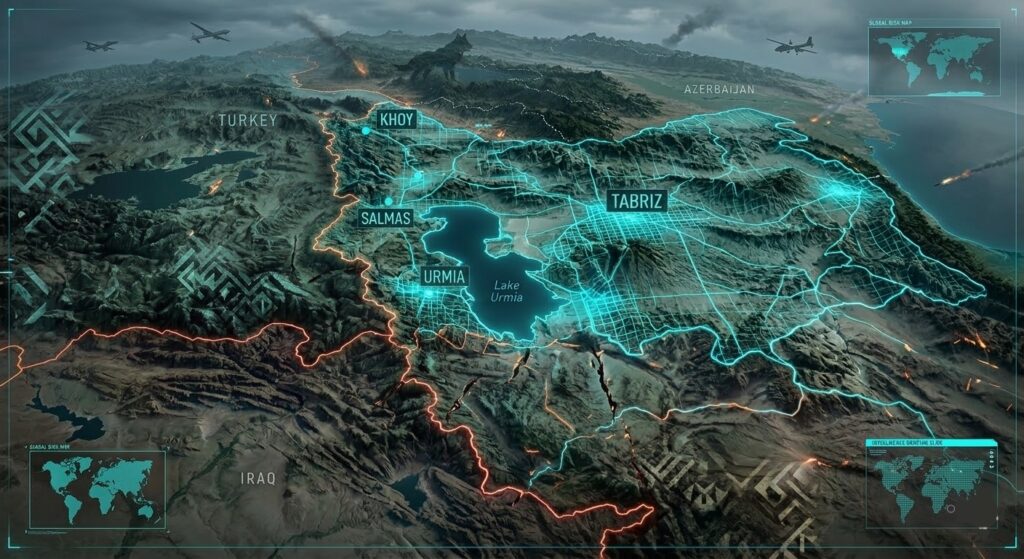
The geopolitical crises that have swept the Iranian plateau in early 2026 (1404 in the Solar Hijri calendar) transcend a classic military confrontation between states, acting as a catalyst for the redefinition of identity and territorial boundaries. While extensive US airstrikes under the operation “Epic Fury” and Israeli attacks dubbed “Roar of the Lions” have pushed the Islamic Republic’s defense infrastructure and command structure to the brink of collapse, leading to the physical elimination of Ali Khamenei, the historical fault lines between the Kurdish and Turkish nations in northwestern Iran have become active on an unprecedented scale. This report aims to provide an in-depth, multi-faceted examination of the current state of governance amidst the war, a critique of the political statements of Kurdish parties, an analysis of territorial claims in West Azerbaijan, and an outline of the perspective for a post-Islamic Republic order.
The Decline of Central Authority and the Islamic Republic’s Survival Paradigm in War
The Islamic Republic is currently facing the most severe crisis of legitimacy and efficiency in its history. Israel’s military strategy, executed in three main phases—destruction of defense sites, disabling of missile launchers, and utilization of drone bases deep within Iran—has effectively severed the regime’s deterrent arm. In such a situation, the ruling establishment has concluded that it is not necessarily the absolute loser only in a war scenario; because war can remove human rights concerns from the global agenda and overshadow internal divisions with state nationalism. However, the death of Ali Khamenei and the transfer of power to Mojtaba Khamenei amidst fire and blood has not created stability but has led to further erosion of the state’s traditional instruments of control.
In this ambiguous atmosphere, the ruling establishment uses ethnic confrontations as a tool of “divide and rule.” Field reports indicate that in West Azerbaijan province, security forces sometimes show tolerance towards the display of extremist ethnic symbols, attempting to divert public attention from fighting the external enemy towards internal conflict between Turk and Kurd. While this survival strategy might prolong the regime’s life in the short term, it has raised the explosive potential of northwestern Iran to a level that could confront the territorial integrity of the Iranian plateau with an irreversible challenge in the post-Islamic Republic order.
Critique of the Kurdistan Parties Coalition Statement and the Challenge of Defining “Nation”
The announcement of the establishment of the “Coalition of Political Forces of Iranian Kurdistan” (including parties such as the Democratic Party of Iranian Kurdistan (KDPI), Komala, PJAK, and PAK) appears at first glance as an effort to organize the opposition. However, the statements of this coalition contain codes that have provoked deep distrust among Azerbaijani activists. The fundamental criticism of this statement is its ambiguous use of terms such as “nations” and “redesigning Iran,” which are raised without presenting a clear map of internal borders. Azerbaijani activists believe this language serves as a cover for territorial claims in areas with mixed population compositions.
Another point of contention is the presence of the Kurdistan Free Life Party (PJAK) in this coalition. PJAK, known as the Iranian branch of the PKK, has been viewed by not only the Islamic Republic but also by Turkey and even the United States at various times as a terrorist organization or affiliated with transnational military networks. From a strategic perspective, the presence of such a force in a political coalition claiming to seek democracy signifies the introduction of a military and guerrilla phase into future political equations, which could replace democratic dialogue between Turks and Kurds with the language of guns.
Historical Analysis of Turk-Kurd Relations in the Geography of West Azerbaijan
The roots of current disagreements should not be sought solely in contemporary developments; these tensions are embedded in the deep layers of Iran’s modern history. Two key events, the sedition of Sheikh Ubeydullah Nehri and the rebellion of Ismail Agha Simko (Simitqu), remain unhealed wounds in the collective memory of Azerbaijani Turks. In 1880, Sheikh Ubeydullah, aiming to establish an independent Kurdistan, launched a widespread attack on the cities of Urmia, Miandoab, and Bonab, leading to the massacre of over 30,000 Turkish inhabitants of the region. This attack, accompanied by unprecedented brutality, laid the foundation for religious and ethnic mistrust in northwestern Iran.
In the subsequent phase, Ismail Agha Simitqu (Simko), exploiting the power vacuum after World War I and the chaos of the central government, engaged in looting and massacres in the regions of Lakestan, Salmas, and Urmia. The murder of Mar Shimun Benyamin and participation in the massacre of Assyrians and Turks turned Simko into a symbol of ethnic terror in the minds of Azerbaijanis. Today, efforts by Kurdish parties to rehabilitate Simko’s image and present him as a national hero are perceived by Azerbaijanis as a clear message that any weakness in the central government will be met with territorial aggression and ethnic cleansing. This historical background casts doubt on any democratic statement from Kurdish parties in the eyes of Azerbaijani activists.
The Issue of West Azerbaijan and Expansionist Symbols
West Azerbaijan province, due to its strategic location bordering Turkey, Iraq, and the Republic of Azerbaijan, has become a focal point for territorial claims. Kurdish parties, in their statements and propaganda maps, depict vast portions of this province, including the city of Urmia, as part of a “Greater Kurdistan.” These maps, which go beyond traditional Kurdish areas and include Turk-populated cities, are academically known as “expansionist cartography,” aiming to create new ground realities in the post-collapse era.
In response, the Turkic nation of Azerbaijan, emphasizing its historical and demographic identity, considers any change in the administrative boundaries of West Azerbaijan as its red line. The use of “Grey Wolf” symbols in Urmia protests is an identity-based response to these claims. Strategically, for Turks, West Azerbaijan is not just a province but a communication gateway to the Turkic world and Turkey. Any political consolidation of Kurds in this region that cuts off Azerbaijan’s geographical connection with Turkey is viewed as an existential threat that could lead to an all-out war in the area.
Lessons from the 1946 Pact and the Failure of Temporary Cooperation Models
One of the most significant historical junctures in Turk-Kurd relations was the signing of a friendship agreement between Pishevari (leader of the Azerbaijan Democratic Party) and Qazi Muhammad (President of the Republic of Mahabad) in April 1946. This pact, concluded under the pressure and supervision of the Soviet Union, emphasized military and political cooperation against the Tehran government. However, academic reviews show that even then, there were intense disputes over regions like Naqadeh (Sulduz) and Oshnavieh (Shino), and the cooperation was more tactical than strategic.
The rapid collapse of both local governments following the withdrawal of Soviet forces demonstrated that without a stable legal structure and agreement on internal borders, ethnic alliances quickly disintegrate under external pressure and internal contradictions. Today, Kurdish parties try to rebuild their legitimacy by drawing inspiration from the Republic of Mahabad. However, ignoring the fact that the Republic of Mahabad only ruled a small part of the southern province means their current claims over the entire West Azerbaijan province also contradict the historical realities of 1946.
The Role of Regional Actors; Turkey and the Republic of Azerbaijan Amidst the Chaos
The 2026 war has shifted the balance of power in the Middle East in favor of Turkey and the Republic of Azerbaijan. Turkey is deeply concerned that the collapse of the Islamic Republic could lead to the empowerment of the PKK and PJAK along Iran’s western borders. Turkish Foreign Minister Hakan Fidan has repeatedly warned that Ankara will not allow a new order based on terrorist groups to form near its borders. This stance of Turkey creates a strategic alignment with the national interests of Azerbaijani Turks, who also seek to preserve Azerbaijan’s territorial integrity and counter PJAK’s influence.
The Republic of Azerbaijan, following its victory in Karabakh and pursuit of the Zangezur Corridor, is now regarded as a regional power influential over South Azerbaijan. Ilham Aliyev, by emphasizing that “independent Azerbaijan is a source of hope for the Azerbaijanis of Iran,” has effectively entered the identity equation. This bond between Baku, Ankara, and Tabriz has created a strong barrier against the territorial claims of Kurdish parties in West Azerbaijan. In fact, any military or political move by Kurdish parties to dominate the border strip will face not only local resistance but also the potential reaction of regional armies.
Environmental and Economic Crises as a Catalyst for Conflict
In the strategic analysis of West Azerbaijan, the Lake Urmia disaster cannot be overlooked. The destruction of this lake, described by Azerbaijani activists as “environmental genocide,” has led to increased social tensions. Azerbaijanis believe that the ruling establishment, by neglecting the lake’s restoration, aims for the forced migration of Turks and a demographic change in the region favoring other groups. In this context, any territorial claim from Kurdish parties adds salt to the wound of Lake Urmia and doubles the sense of defending the homeland among Turks.
The economic crisis caused by the war, internet blackouts, and paralysis of border trade have pushed local communities towards identity-oriented groups for survival. Poverty and unemployment in Kurdish and border areas have paved the way for recruitment by groups like PJAK, while in Turkic regions, maintaining security and the territorial integrity of Azerbaijan has become the top priority. This economic and social divide has the potential to turn into a civil war over scarce resources in the post-collapse era.
Scenarios for the Post-Iran Order and the Necessity of Strategic Rationality
Based on available data, three main scenarios are conceivable for the future of northwestern Iran. The first scenario is the “Balkanization” of the region; where street clashes begin in mixed cities like Urmia, Sulduz (Naqadeh), and Salmas, leading to military intervention by regional powers. This scenario, the most dangerous possibility, could result in widespread ethnic cleansing and the displacement of millions.
The second scenario is “democratic federalism based on historical borders.” In this scenario, Kurdish parties, by retreating from expansionist maps and accepting the Turkic identity of West Azerbaijan, would enter constructive dialogue with Azerbaijani elites to create a model of shared governance or autonomy in ethnically homogeneous areas. However, realizing this scenario requires Kurdish parties to abandon provocative symbols like “Greater Kurdistan” and remove PJAK from their equations.
The third scenario is the formation of a secular centralized government in Tehran attempting to suppress all ethnic movements through military means. While this scenario might create short-term stability, due to the depth of identity demands in Azerbaijan and Kurdistan, it would only delay the crisis and lead to an accumulation of national anger.
Conclusion and Strategic Recommendations
This report demonstrates that northwestern Iran is on a razor’s edge amidst the 2026 war. The Islamic Republic’s survival policies, based on provoking ethnic divisions, combined with the ambiguous statements and expansionist maps of Kurdish parties, have created an atmosphere of absolute mistrust. To prevent a catastrophe during the transition period, it is necessary that:
- First, Kurdish parties explicitly align their claimed geographical boundaries with the demographic and historical realities of West Azerbaijan and exclude Turkic cities from their maps.
- Second, Kurdish activists, understanding regional powers like Turkey and the Republic of Azerbaijan, avoid becoming pawns in geopolitical games and focus on models of democratic coexistence.
- Third, the international community and coalition forces (USA and Israel), in the post-Islamic Republic order, must be aware of the sensitivities of ethnic borders in Iran and avoid strengthening one side at the expense of annihilating the other, because any instability in West Azerbaijan could spread to the entire Caucasus and Anatolia region.
Iran is on the verge of change, but if this change is not based on territorial justice and respect for the historical identities of nations, the war with the external enemy will only be a prelude to endless internal wars. Careful analysis of developments in Urmia and political statements indicates that peace on the Iranian plateau depends not in Tehran, but on reaching a just agreement between Tabriz and Mahabad.