Dr. Hamid Shahanaghi
Strategic Abstract
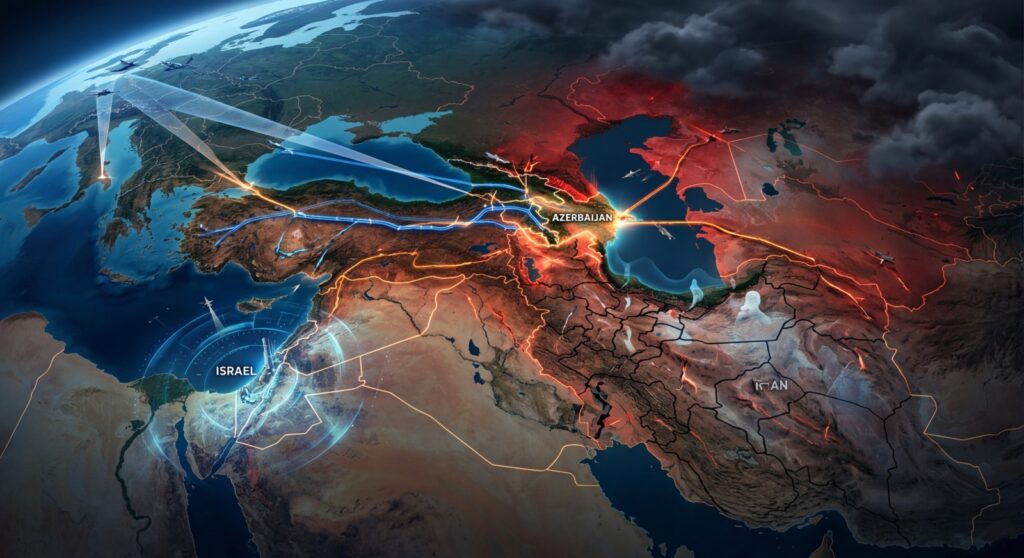
The ongoing war between Iran on one side and the United States and Israel on the other is no longer just a limited military conflict; this war is rapidly redefining the geopolitical map of the Middle East and its surroundings. The Republic of Azerbaijan, a country located at the crossroads of the Caucasus, Russia, Iran, and the Turkic world, has been exposed to the contradictory and complex consequences of this crisis more than many other actors. Baku’s current position can be summarized in one sentence: “A potential winner standing on the front line of danger.”
The military and political developments of late February and March 2026 have exposed West Asia and the Caucasus to one of the greatest historical ruptures. This report provides a comprehensive analysis of the consequences of this conflict on Baku across political, security, economic, and energy dimensions, and examines the grand strategies of Baku and Tehran until March 30, 2026, with a special focus on the factor of the 30-40 million Turks of South Azerbaijan.
Political Dimensions: Cautious Diplomacy and Balancing in the Era of the Collapse of the Old Order
Azerbaijan’s foreign policy for the past three decades has been based on one key principle: balancing between powers. This country has managed to maintain close relations with Israel and benefit from its security and technological cooperation, while simultaneously engaging with Iran, a sensitive neighbor with historical, religious, and ethnic ties. But the war has made this equation extremely complex.
The Republic of Azerbaijan has chosen a policy of “active neutrality” in the face of the ongoing war. From the first days of the US and Israeli-led coalition’s airstrikes, Baku explicitly stated that it would not allow its territory or airspace to be used for attacks against its southern neighbor. However, developments such as targeted assassinations of senior Iranian officials (including the succession of Mojtaba Khamenei in place of his father on March 8, 2026, and the elimination of top commanders of the IRGC and army) have heavily securitized the political atmosphere around Baku.
At the macro-political level, Baku’s relations with the involved powers have entered a new phase. Despite cooperation on the TRIPP transit project, the US is exerting increasing pressure on Baku to comply with new sanctions against Iran. Additionally, pressure for Azerbaijan to join the “Abraham Accords” and play a role in the reconstruction of Gaza has put Baku in a difficult position. In contrast, the strategic partnership with Israel in drone and intelligence fields has exposed Baku to asymmetric threats from the IRGC. On the other hand, Russia, which previously had tensions with Baku due to the downing of an Azerbaijani civilian aircraft, is now rapidly normalizing relations to use Azerbaijan as a logistical partner in the North-South Corridor. At the same time, the full defense alliance with Turkey under the Shusha Declaration has allowed Baku to plan, in coordination with Ankara, for the management of a potential power vacuum in Iran. Turkey opposes coalition military intervention for regime change in Iran and warns that the collapse of Iran could lead to a “failed state.”
International think tanks call this situation “cautious multilateralism under pressure”; a situation where the maneuvering space has become extremely limited. Every move by Baku can be interpreted as “taking sides”: proximity to Israel increases the risk of an Iranian reaction, while distancing from it weakens security and technological support.
Security Dimensions: The War Has Reached the Borders
Unlike many past regional crises, this time the war has effectively reached Azerbaijan’s borders. Drone attacks near Nakhchivan and increased border tensions indicate that this country is no longer just an observer but is directly exposed to security consequences.
The drone attack on March 5, 2026, targeting Nakhchivan International Airport and a school, resulting in the injury of four civilians, was a turning point in bilateral tensions. In response, Baku has activated “Iron Dome” and “Barak” air defense systems. In the layer of hybrid threats, Azerbaijani security agencies have foiled several plots linked to the IRGC, including plans to attack the Ashkenazi Synagogue, the Israeli Embassy, and bomb the BTC pipeline and key bridges. Also, the risk of biological terrorism or leakage from damaged facilities has led to the implementation of public safety protocols and radioactive monitoring at borders. In cyberspace, the Iranian cyber army has targeted Azerbaijan’s banking infrastructure, which is being countered with the cooperation of Israeli and US cyber defense companies.
One of the main concerns is Azerbaijani territory becoming an arena for indirect competition between Iran and Israel. The deployment of coalition forces and the use of AI systems like Maven for targeting inside Iran have caused debris from intercepted missiles to frequently fall in Azerbaijan’s border regions.
Instability on the borders, especially the potential for conflict between Kurds and Azerbaijani Turks in western Iran, has forced Baku to strengthen its military presence and deploy special forces along the Aras River and the Aras Dam. On a broader scale, some analysts warn that if the war continues or intensifies, the South Caucasus could become one of the first spillover zones of the crisis; a scenario whose consequences would be far beyond Baku’s control.
At the same time, Azerbaijan has become a vital route for evacuating foreign nationals from Iran. While this role strengthens Baku’s international standing, it places significant pressure on border infrastructure and internal security.
Economic and Energy Dimensions: Short-Term Gain, Long-Term Risk
From an economic perspective, the picture is dual. The closure of the Strait of Hormuz in early March 2026 confronted the global oil market with the biggest supply crisis, pushing Brent crude prices from around $75 in February to above $120 by March 30. This situation has created an additional monthly revenue of $500-600 million for Azerbaijan, which had based its budget on $65 oil. With the manat strengthening due to a positive trade balance, the government’s purchasing power for advanced weapons has increased.
But this is only one side of the story. The war simultaneously increases the risk of stagflation in the global economy; a phenomenon that could reduce demand for energy in the medium term.
Container transit costs have increased by over 150% due to war insurance, which has enhanced the attractiveness of Baku Port and the Baku-Tbilisi-Kars (BTK) railway as alternative routes. In contrast, imports from Iran, which previously constituted 2.6% of Azerbaijan’s total imports, have completely stopped due to border closures, leading to food shortages and inflation in border regions. The Japanese company INPEX has also changed its strategy, redirecting barrels of oil produced in Azerbaijani fields, which previously went to Europe, directly to Japan due to the blockage of the Strait of Hormuz.
In the region’s transit map, the 2026 war has led to major structural changes. The Middle Corridor (TITR), with unprecedented container growth and a 260% increase in cargo volume, has become the main route connecting China to Europe. The North-South Corridor (INSTC), despite war constraints, has become Russia’s main tool for economic breathing and circumventing sanctions. With US support and Iran’s diminished deterrent capability, political negotiations to finalize the Zangezur Corridor and the TRIPP project, which bypass Iran, have accelerated. In contrast, the Aras route has lost its appeal and is effectively suspended due to insecurity on Iranian territory and the closure of borders by Baku.
The energy sector is perhaps where this paradox manifests itself more than any other area. On one hand, Azerbaijan finds itself in an unprecedented position as an alternative energy supplier for Europe. With 11.8 billion cubic meters of gas exported to Europe and supplying 40% of Israel’s oil, Azerbaijan has become an indispensable pole in energy security. Rising prices and concerns about the security of the Strait of Hormuz have doubled the importance of the country’s gas and oil. But on the other hand, this importance makes it a potential target. Energy infrastructure – from pipelines to production facilities – could be threatened in war escalation scenarios. In other words, the more prominent Azerbaijan’s role in the energy market becomes, the higher its geopolitical risk grows.
The tourism and transport sectors have also not been spared from this crisis. Reduced regional travel, flight cancellations, and increased security risks mean declining revenues in these areas.
The South Azerbaijan Factor: National Awakening and Tehran’s Security Nightmare
The 30-40 million population of South Azerbaijani Turks as of March 2026 has become the driving engine of internal developments in Iran. This population, comprising about 35-40% of Iran’s population, has become highly active in terms of national identity and language. While Tehran suppresses this movement as “Pan-Turkism” and a threat to territorial integrity, Baku uses it as a tool of soft power and diplomatic pressure.
The potential for unrest in cities like Tabriz has forced Tehran to deploy Saberin special units and security forces to the northwest. In contrast, while maintaining readiness for humanitarian crisis management and limited logistical support, Baku refrains from directly inciting separatism to prevent spillover ethnic conflicts. Iran’s fear of losing access to Armenia (Zangezur Corridor) has clashed with Baku’s insistence on national sovereignty and connection to Nakhchivan via Iranian or Armenian territory. Furthermore, public opinion in South Azerbaijan, due to historical discrimination and the war-induced economic crisis, has become increasingly distanced from the central government, and Ilham Aliyev has gained popularity as a spiritual leader among Iranian Azerbaijani youth.
Any weakening of the state structure in Iran could turn this issue into a serious geopolitical factor; a factor that is both an opportunity and a threat for Baku.
The Institute for the Study of War (ISW) and Chatham House believe that the weakening of Iran’s missile capability (destruction of about one-third of its stockpiles) and the end of the “forward defense” strategy have placed Baku in a more aggressive position. Meanwhile, the Hudson Institute warns that in the event of the collapse of the Tehran regime, Baku will face strong internal pressure to intervene in South Azerbaijan.
The Future: Four Possible Paths
Azerbaijan’s future is strongly tied to the path of the war:
- Continuation of War: Baku will face a combination of high revenue and chronic insecurity.
- Weakening of Iran: New geopolitical opportunities will emerge, but alongside them, border instability will also increase.
- Collapse of Iran (Scenario far from certain): Could be a major security shock for the entire Caucasus.
- De-escalation and Agreement: Could pave the way for stability and economic growth.
Conclusion: A Dangerous Game on the Edge of Balance
Iran’s war with the US and Israel has placed Azerbaijan in a position that few countries have experienced: a simultaneous combination of strategic opportunities and existential threats. A comprehensive review of developments until the end of March shows that the Republic of Azerbaijan has been able to largely transform the threats arising from the war into an opportunity to consolidate its regional hegemony. The weakening of Iran, the national awakening in South Azerbaijan, and the surge in oil revenues have positioned Baku to redefine the geopolitical map of the Caucasus for decades to come.
However, the risk of uncontrolled collapse in Iran and the spread of ethnic conflicts remains the biggest threat to sustainable stability in Baku. This country today is not merely a regional actor, but part of a larger global energy and security equation. But the more important its role becomes, the smaller its margin of safety grows.
Ultimately, Azerbaijan’s fate in this crisis depends not only on Baku’s decisions but also on the path this war will take in the coming months and years. Until then, this country will continue to walk on a fine edge; a balance between opportunity and danger, profit and insecurity, and power and vulnerability.