THE SOUL OF A DIVIDED NATION: SOUTH AZERBAIJANI LITERATURE AND THE QUESTION OF NATIONAL IDENTITY

Prof. Dr. Parvane Memmedli Literature is the soul of a nation. Understanding this soul, bringing its unwritten pages to light, is not merely the duty of literary scholars but the collective moral responsibility of an entire people. One of the geographies where this responsibility appears most vital is undoubtedly Azerbaijan, a land of a divided nation. The ongoing discussions regarding South Azerbaijani literature today are, in essence, about charting the strategic map of a people’s struggle to preserve their cultural existence and their resistance against geopolitical fragmentation. The Voice of Fragmentation in Literature When examining the history of world nations, the 19th century stands out as a period when statist ideas strengthened and fragmented lands were unified. For Azerbaijan, however, this century was, on the contrary, marked by fragmentation, alienation, and invasions. The treaties of Gulistan in 1813 and Turkmanchay in 1828 were not merely diplomatic documents; they were sharp borders drawn across the soul of a nation. This border was experienced in the national memory not just as a political division but as a fragmentation of culture, language, and kinship ties.South Azerbaijan, a millennium-old cultural cradle, had always been a source for the North. Yet this source was forcibly sealed off, and foreign hands reached out to a people divided in two. It was at this precise point that literature became not merely an aesthetic activity but a form of resistance, a mode of existence. Double-Layered Oppression and the Sanctuary of Language From the mid-20th century onward, South Azerbaijani literature was shaped under a double-layered pressure: on one side, the assimilation policies of Persian chauvinism; on the other, the separation from Soviet Azerbaijan. This fragmentation created deep divides not only in the political geography but also in human consciousness. For the poets of the South, “language” became both a tool of struggle and the last sanctuary of national identity.The “language ban” policy during the Reza Shah era transformed Azerbaijani Turkish into a culture hidden within homes. Yet this concealed culture did not perish, thanks to its deep roots. Literature undertook what politics could not achieve: the sorrow of the South lived on in poetry, novels, and journalism. Motifs of Tabriz were woven into the works of Northern writers such as Samad Vurgun, Suleyman Rustam, Mir Jalal, Mehdi Huseyn, M.S. Ordubadi, and Mirza Ibrahimov. When Shahriyar’s “Greetings to Heydar Baba” was read in the North, it struck like a spark in the memory of a divided people. Bakhtiyar Vahabzadeh’s epic “Gulistan” laid bare the poetic condemnation of political borders. 1941–1946: Fleeting Hope, Enduring Traces The entry of Soviet troops into Iran in 1941 marked a new chapter in the history of the Azerbaijani people. For the first time, a living communication was being established between people who had been separated for years on the two banks of the Aras. This was not merely a political event but an awakening of national memory. The intellectuals who went south within the Soviet army played roles as both propagandists and cultural bridges.Yet this hope was short-lived. Neither the agreement between the Soviet Union and Iran nor international power balances recognized the political independence of South Azerbaijan. For the world powers, this issue was not about an ideal of national liberation but a matter of geostrategic balance. The fall of the National Government in 1946 and the tragic end of Pishevari opened a new phase in Southern literature: thousands of intellectuals, writers, and poets migrated north – to Soviet Azerbaijan.This migration was an event that changed the fate not only of politics but also of the literary milieu. Balash Azaroglu, Madina Gulgun, Sohrab Tahir, Ali Tude, Gahraman Gahramanzadeh, Hakime Billuri, and many others became integral parts of the literary world of the Azerbaijan SSR. Their poetry was the poetry of longing for the homeland, of exile, of fragmentation, and simultaneously, of hope. By keeping the issue of the South constantly on the agenda in their works, Southern poets etched it into the national memory of the Northern reader. Cultural Resistance and the Legacy Carried to Today One of the most important characteristics of South Azerbaijani literature is that it constitutes a “literature of cultural resistance.” For these poets, writing was not merely an aesthetic act but a means of preserving national existence. During the Pahlavi era, sorrow, deprivation, fear, and alienation became the defining features of the literary style. Yet it was precisely within this sorrowful literature that the seeds of future aspirations for freedom were preserved in the creativity of Shahriyar, Sahir, Sahand, Savalan, Muhammad Birya, Ali Fitrat, Mir Mehdi Etemad, and hundreds of lesser-known poets. Through images such as “the unfinished homeland,” “lost land,” and “captive language,” they gave voice to the divided fate of their people.Another strategic dimension of this literature was the spiritual bridge it established between the North and the South. Despite their stylistic differences, Samad Vurgun’s romantic aspiration, Suleyman Rustam’s nostalgic emphasis on brotherhood, and Rasul Rza’s symbolic-philosophical approach were all expressions of a shared national sentiment. Though left unfinished politically, this bridge created a holistic “national landscape” on the literary plane. Without Literature, National Will Remains Incomplete As Victor Hugo stated, behind every political revolution lies a cultural revolution. Although the political history of the Azerbaijani people may be etched into memory with defeats and unfinished movements, the cultural revolution – that is, literature – preserved the people’s soul. Today, as two wings complementing each other, Southern and Northern literature ensure the ascendance of a holistic national culture.As Prof. Dr. Yashar Karayev rightly emphasized, it was not political slogans but poetry that kept this nation united until today. Even though the Aras River divides the land, poetry did not allow itself to become an Aras flowing between hearts. A people’s paralysis could have only occurred with the severing of these literary veins. Yet that vein still lives on.Bringing to light the unwritten pages of South Azerbaijani literature, systematically researching this heritage, and constructing a shared cultural memory on both banks must be a priority not only
“QIZIL SƏHİFƏLƏR”: THE FOUNDATIONAL MANIFESTO OF THE SOUTH AZERBAIJAN NATIONAL CONCEPT
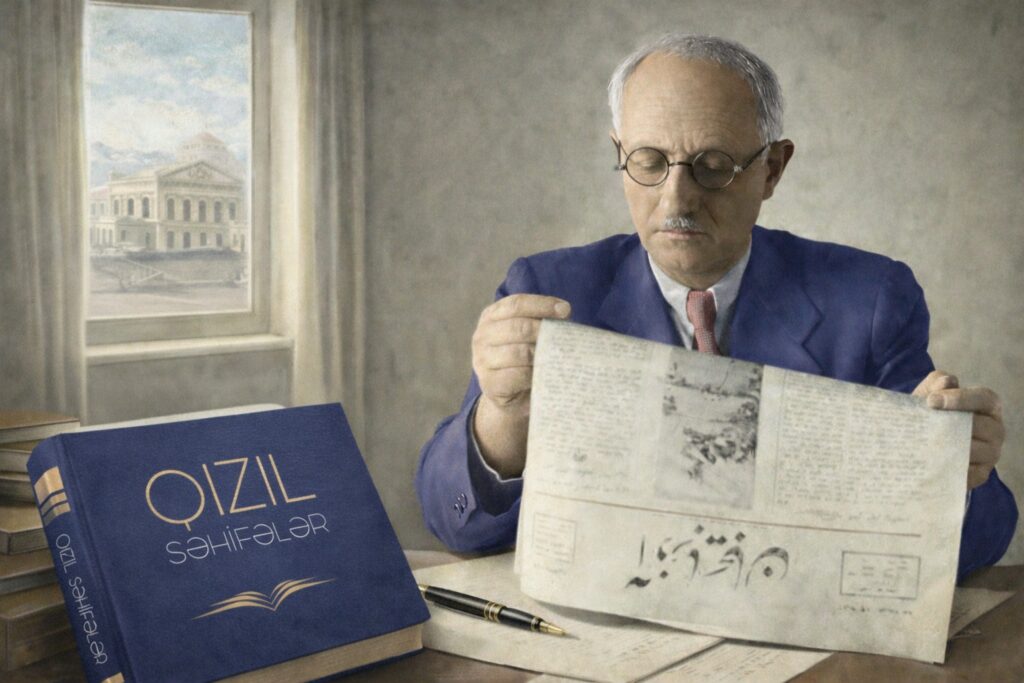
The National Government established in South Azerbaijan between 1945 and 1946 represents not merely a regional political transformation, but also the first comprehensive process of state formation and identity construction of Azerbaijani Turkdom in the modern era. The most concrete and enduring intellectual legacy of this period is the work titled “Qızıl Səhifələr” (From the History of the Struggle of the Azerbaijani People on the Path of National Liberation), printed in 1946 at the “Elmiyye” printing house in Tabriz. Examined in depth by Dr. Pervane Memmedli, this work constitutes a vivid chronicle encompassing the political-journalistic legacy of Seyid Cafer Pişeveri, the founding leader of the National Government, the core programs of the Azerbaijan Democratic Party (ADP), and the people’s struggle for language, identity, and sovereignty. This report provides an in-depth analysis of the content of this work, its historical context, and its significance for South Azerbaijan strategic studies.