BAKU IN THE AGE OF GEOECONOMIC WARS AND THE MULTIPOLAR ORDER
The “Global Risks Report 2026” published by the World Economic Forum portrays a world that has entered an “age of competition”; a world in which multilateralism is weakening and states are competing more aggressively than ever through economic, technological, and security instruments in order to expand their influence.
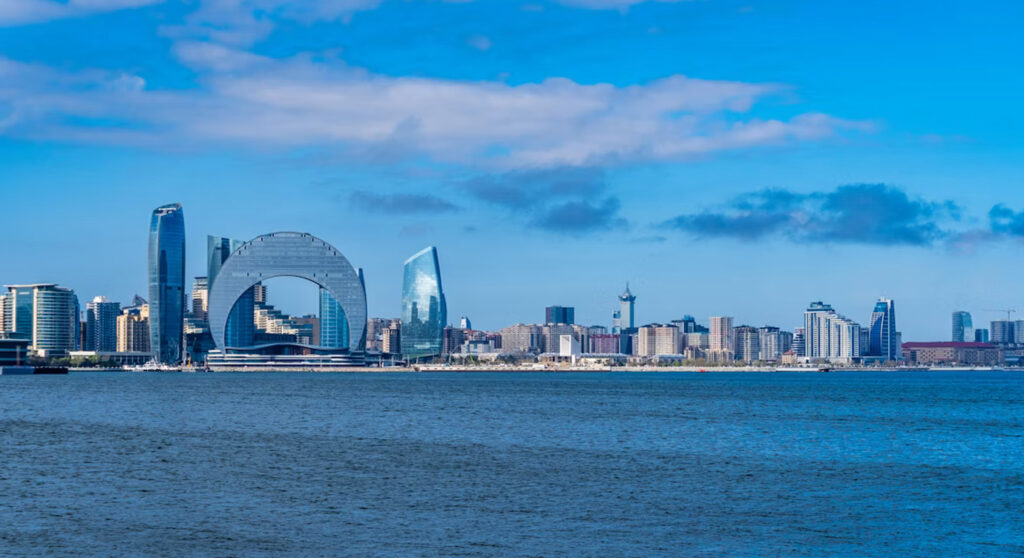
When we read this report from the perspective of Azerbaijan, it becomes clear that Baku stands at the very center of many of the developments highlighted in the report: geoeconomic wars, energy competition, crises over transportation corridors, regional tensions, and the redefinition of the balance of power in Eurasia.
In fact, the world described in the WEF report is precisely the world in which Azerbaijan has been rapidly consolidating its position in recent years.
THE ISLAMIC REPUBLIC, BALANCE OF POWER, AND THE NATIONALITIES QUESTION IN IRAN
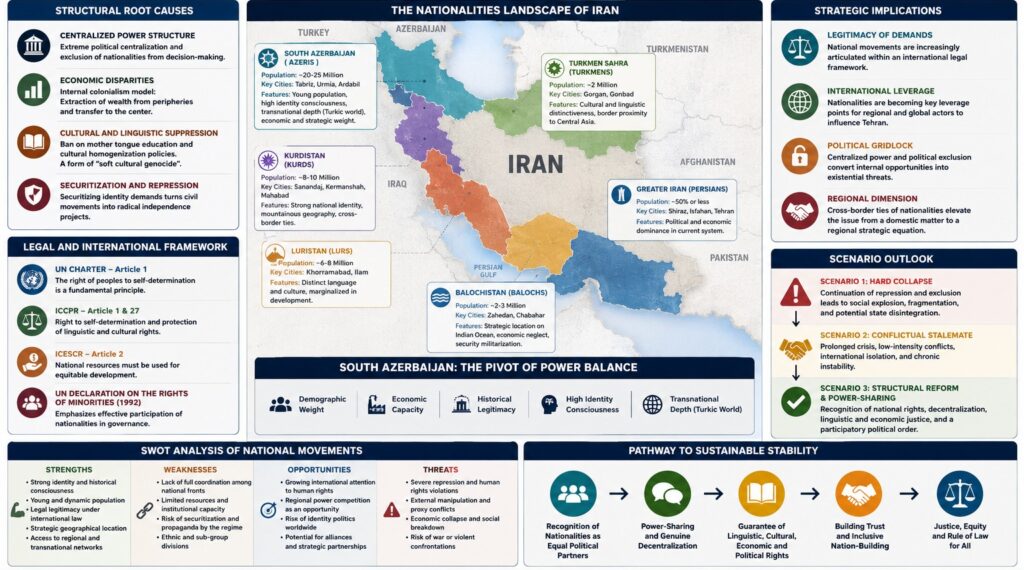
The nationalities question in Iran is no longer merely a cultural or identity-based issue. It has evolved into one of the central strategic variables shaping the political survival of the Islamic Republic and the future political order of the country. Any serious strategic assessment of Iran’s future must recognize that the widening gap between the center and the peripheries has simultaneously acquired legal, economic, security, and geopolitical dimensions.
Over the past four decades, the Islamic Republic has attempted to manage the nationalities issue through securitization, cultural control, and centralized governance. The outcome, however, has not been sustainable integration, but rather the accumulation of structural grievances. Today, a significant portion of political forces in non-Persian regions have moved beyond demands limited to cultural rights and entered a phase of political and governance-oriented mobilization. This transformation has fundamentally altered the nature of the crisis.
TRANSATLANTIC DIVERGENCE IN THE IRANIAN ISSUE:TEMPORARY TENSION OR STRUCTURAL DIFFERENTIATION?
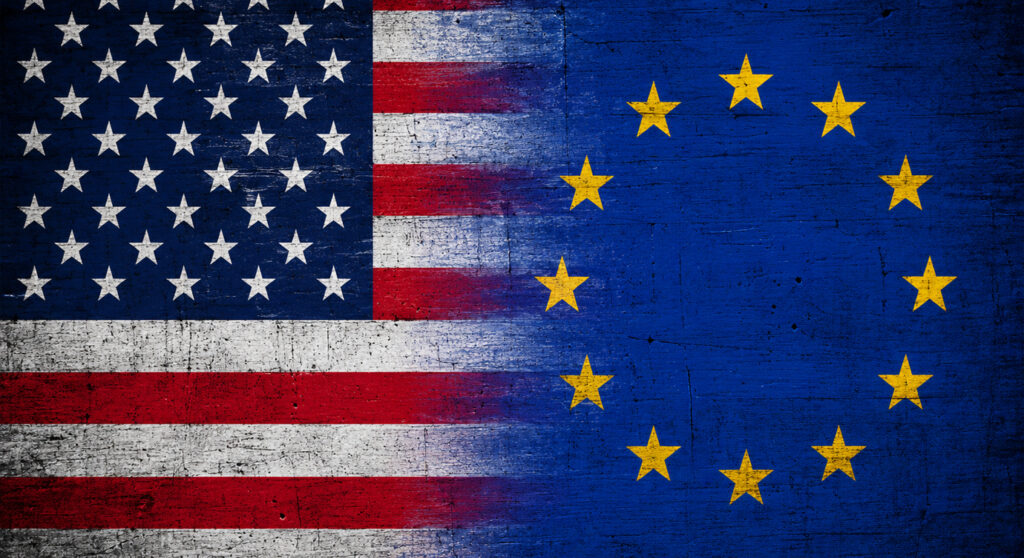
Geopolitical developments in the Middle East in 2026, particularly the rising tensions surrounding Iran and the disruptions to maritime transport in the Strait of Hormuz, have brought one of the most significant fractures within the Western world back into view: the transatlantic divergence between the United States and the European Union. Although these two actors have generally adopted a common stance on many security issues within the framework of their traditional alliance, significant differences in approach, instruments, and priorities regarding Iran are emerging.
The Iranian issue, especially concerning its nuclear program and regional role, holds strategic importance for both sides. However, what distinguishes this issue in 2026 is not merely the nature of the threat but also the form of response to it. The United States, particularly within the framework of its “maximum pressure” policy, aims to rapidly and decisively constrain Iran through a combination of economic and military instruments. In contrast, the European Union emphasizes the continuation of diplomacy, negotiation, and the gradual management of the crisis, avoiding an escalation of tension that could entail direct economic and security costs for the continent.
CONSEQUENCES OF IRAN’S WAR WITH THE US AND ISRAEL ON THE REPUBLIC OF AZERBAIJAN
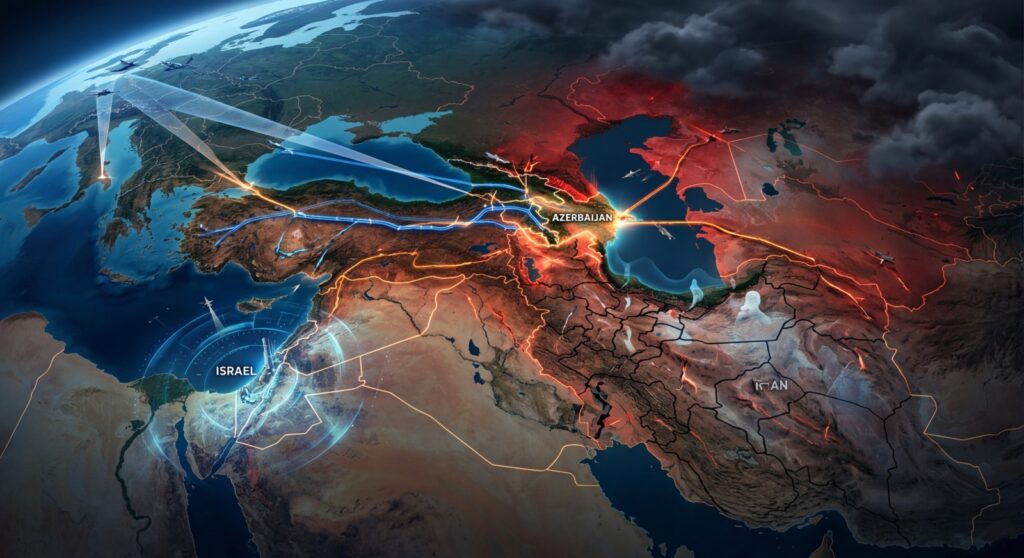
The ongoing war between Iran on one side and the United States and Israel on the other is no longer just a limited military conflict; this war is rapidly redefining the geopolitical map of the Middle East and its surroundings. The Republic of Azerbaijan, a country located at the crossroads of the Caucasus, Russia, Iran, and the Turkic world, has been exposed to the contradictory and complex consequences of this crisis more than many other actors. Baku’s current position can be summarized in one sentence: “A potential winner standing on the front line of danger.”
The military and political developments of late February and March 2026 have exposed West Asia and the Caucasus to one of the greatest historical ruptures. This report provides a comprehensive analysis of the consequences of this conflict on Baku across political, security, economic, and energy dimensions, and examines the grand strategies of Baku and Tehran until March 30, 2026, with a special focus on the factor of the 30-40 million Turks of South Azerbaijan.
THE WATCHFUL DRAGON; CHINA AND THE MILITARY CRISIS BETWEEN IRAN, THE UNITED STATES, AND ISRAEL
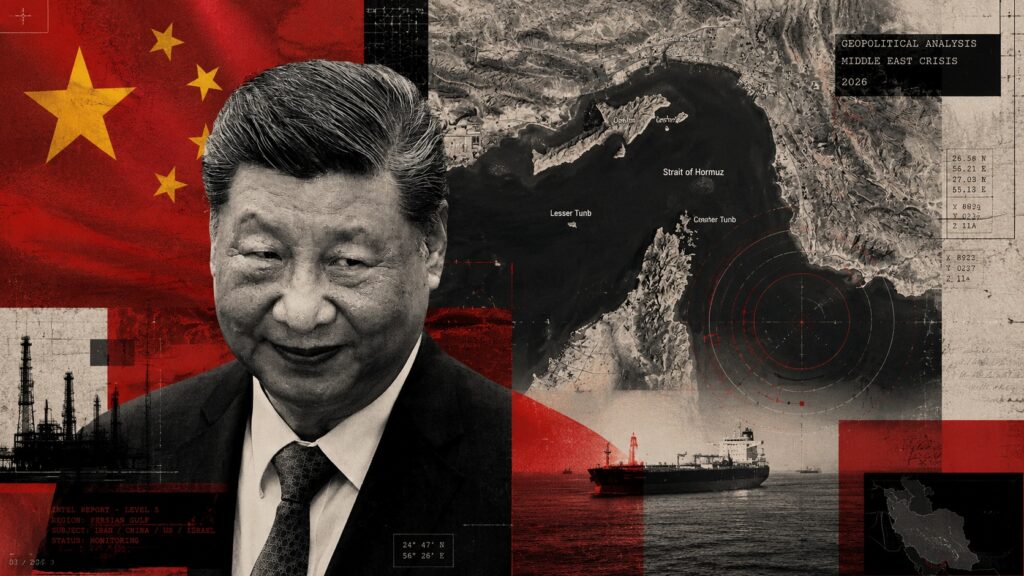
Military developments in the Middle East, initiated by an operation referred to as “Operation Epic Fury” carried out by the United States and Israeli forces against Iran’s nuclear and military infrastructure, have ushered the global geopolitical order into a new phase of instability. In this context, the People’s Republic of China, the world’s largest energy importer and Washington’s primary strategic rival finds itself in a complex and multidimensional position, oscillating between the necessity of safeguarding energy security, protecting its core interests in Taiwan, and attempting to redefine the international order within the framework of the “Global Security Initiative” (GSI). By the end of March 2026, Beijing’s strategy toward this war has evolved from a meaningful initial silence to an active yet non-interventionist diplomacy, with the ultimate aim of capitalizing on the erosion of U.S. power in the region and strengthening Tehran’s strategic dependence on Beijing in the long term.
STRATEGIC ANALYSIS OF CONFLICTS BETWEEN TURKS AND KURDS IN IRAN
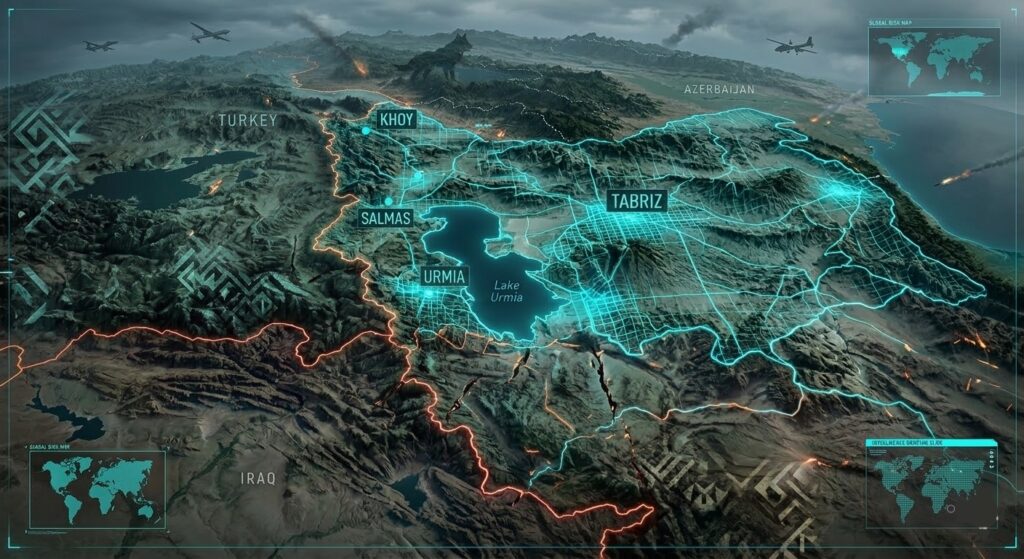
The geopolitical crises that have swept the Iranian plateau in early 2026 (1404 in the Solar Hijri calendar) transcend a classic military confrontation between states, acting as a catalyst for the redefinition of identity and territorial boundaries. While extensive US airstrikes under the operation “Epic Fury” and Israeli attacks dubbed “Roar of the Lions” have pushed the Islamic Republic’s defense infrastructure and command structure to the brink of collapse, leading to the physical elimination of Ali Khamenei, the historical fault lines between the Kurdish and Turkish nations in northwestern Iran have become active on an unprecedented scale. This report aims to provide an in-depth, multi-faceted examination of the current state of governance amidst the war, a critique of the political statements of Kurdish parties, an analysis of territorial claims in West Azerbaijan, and an outline of the perspective for a post-Islamic Republic order.
THE BLOODY BALANCE SHEET AND THE COLLAPSE OF THE REGIONAL ORDER: A ANALYSIS OF THE STRATEGIC CONSEQUENCES OF THE MIDDLE EAST WAR

As the world watches the flames of fire in the Middle East, the geopolitical order that had dominated the region for decades has turned into a pile of ashes in less than 100 hours. The launch of the joint US-Israeli operation at dawn on February 28, 2026, was not just a conventional military confrontation, but the beginning of a fundamental transformation in the political and economic geography of the world, the dimensions of which have transcended the borders of the Iranian Plateau and extended to the financial markets of New York and the strategic ports of East Asia. This report, examining the various dimensions of this crisis with an expert perspective, delves into the collapse of Iran’s internal structures, the global energy crisis, Turkey’s precarious situation, and the shifting balance of power in the region.
THE GEOPOLITICS OF THE TURAN ROAD: THE ZANGEZUR CORRIDOR, IRAN, AND THE NEW STRATEGIC EQUATION OF THE TURKIC WORLD

In recent years, the transformation in Eurasian geopolitics has brought the “Turan Road,” long discussed as a theoretical concept for the Turkic world, back to the center of the strategic agenda. This historical line, extending from Turkistan to Anatolia, signifies not only the idea of a cultural union but also a new model of geopolitical integration in the fields of trade, transportation, energy, and security.
In this context, the Zangezur Corridor stands out as one of the most critical nodal points of this integration. This line, which would provide a direct land connection between Azerbaijan and Nakhchivan in the South Caucasus, also has the potential to complete the uninterrupted transportation chain between Turkey and Central Asia.
AZERBAIJAN’S PROTEST PARADOX: STRATEGIC AND STRUCTURAL DYNAMICS OF SILENCE
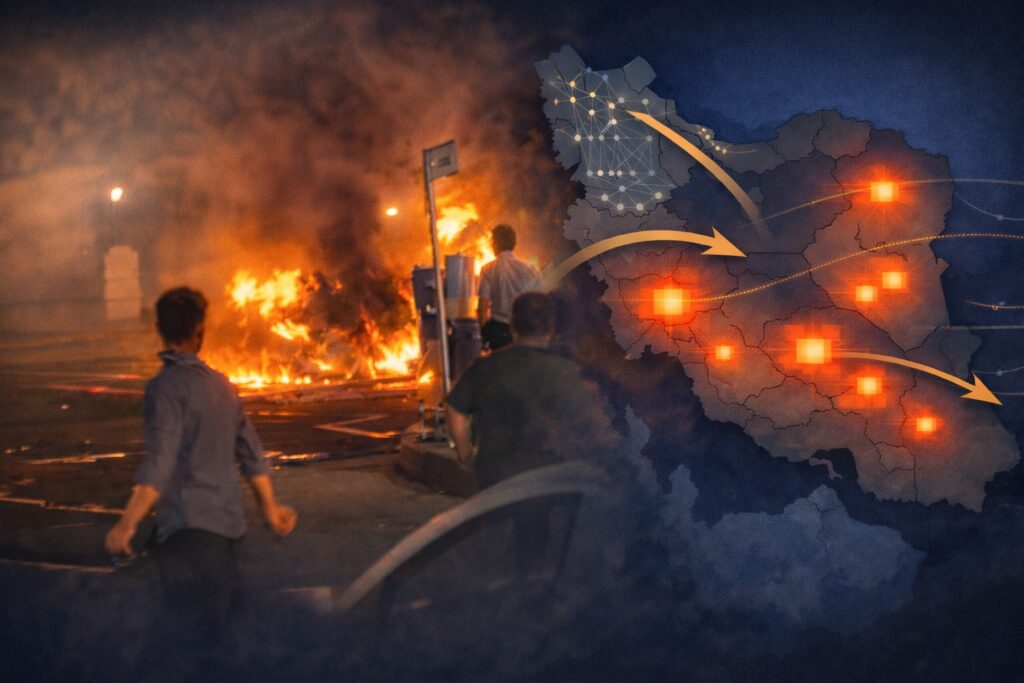
Why has Iranian Azerbaijan shown a low presence in recent nationwide protest movements, or essentially preferred silence and tranquility? This question becomes even more pronounced given the region’s minimal participation in major socio-political events that occurred in 2009, 2017, 2019, 2022, and 2025-26. Although this past December, for two days, some cities in the region, such as Ardabil experienced similar mobilizations as seen in other parts of the country, the protests in Azerbaijan’s provinces and the number of martyrs remained significantly lower compared to other regions. This situation becomes even more complex when we know that Azerbaijan, like other peripheral regions of the country, suffers additional pain from the adverse consequences of centralism and the center’s unjust policies, alongside the usual oppressions.
A REASSESSMENT OF THE REPUBLIC OF AZERBAIJAN’S PUBLIC DIPLOMACY STRUCTURE IN IRAN
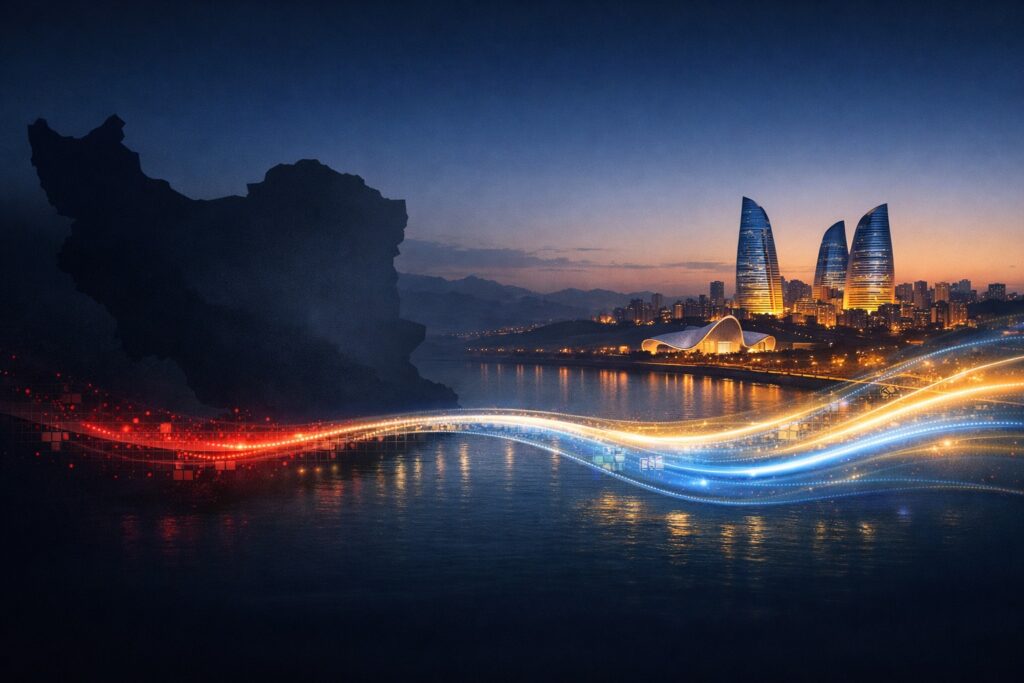
The geopolitical developments in the South Caucasus following the Second Karabakh War in 2020 and the new regional configurations between 2024 and 2026 have established the Republic of Azerbaijan as a pivotal actor in the regional security system. However, despite Baku’s military and diplomatic advancements, its public diplomacy when engaging with non-Azerbaijani segments of Iranian society has consistently faced fundamental challenges. This policy paper, with a strategic and impartial perspective, analyzes the roots of Baku’s failure to penetrate various layers of Iranian society and, by identifying latent potentials, outlines a roadmap for transitioning from confrontation to positive influence. Analyses indicate that despite possessing soft power assets such as a secular development model, modern urban infrastructure, and shared intellectual heritage, Baku has been unable to become an attractive soft power for the general Iranian public due to its reliance on ethno-centric approaches.