An Assessment of the Origins of Anshan and the Early “Achaemenid” Rulers
Dr. İbrahim Halil BALAYOĞULLRAI
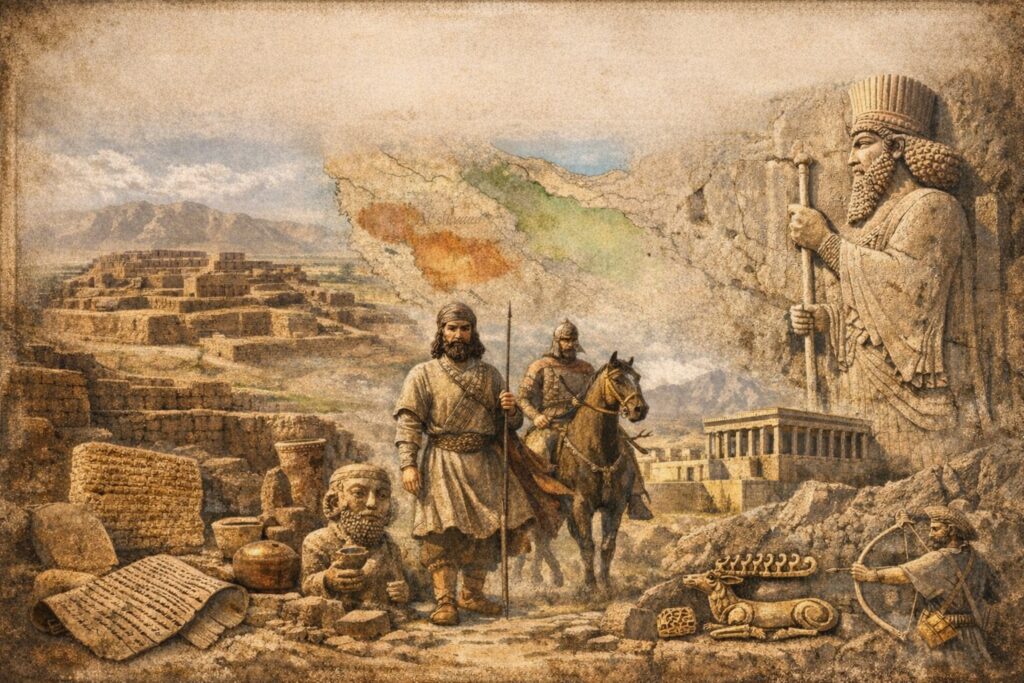
This study subjects the origins of early political figures and geographical centers, typically treated within the narrative of the “rise of the Persian Empire” in ancient Near Eastern historiography to a critical re-examination. Focusing on the Elamite identity of the city of Anshan (Tepe Malyan), the article questions conventional assumptions regarding the ethno-cultural affiliations of figures such as Teispes and Cyrus I. In light of archaeological evidence and primary cuneiform sources, it analyzes the historicity of the so-called “Achaemenid” genealogy, allegedly constructed under Darius I and the prevailing narratives that portray early rulers as ethnically Persian, while also engaging with alternative hypotheses that emphasize Eurasian steppe connections.
State formation and ethnogenesis in the ancient Near East remain subjects of complex debate in modern historiography. In particular, the origins of the political powers that rose on the Iranian Plateau in the mid–first millennium BCE are marked by significant ambiguities, owing both to the scarcity of contemporary sources and to the legitimacy-seeking narratives constructed by later rulers. Traditional historiography has tended to interpret this period as the emergence of a monolithic “Persian” identity. Recent scholarship, however, suggests that this narrative may largely be a product of the official state ideology formulated during the reign of Darius I. By reassessing the strategic significance of Anshan and re-examining primary sources related to key figures such as Achaemenes, Teispes, and Cyrus I, this article aims to explore the complex relationship between early “Achaemenid” history, Elamite heritage, and potentially other Eurasian elements.
1. Anshan (Tepe Malyan): A Strategic Center of Elam
The identification of the mound of Tepe Malyan, located northwest of Shiraz, with the ancient city of Anshan marked a turning point in understanding the region’s history. Mentioned in Sumerian epics such as Enmerkar and the Lord of Aratta, Anshan played a key role from an early period in the commercial and cultural networks linking Mesopotamia and the Iranian Plateau. The city’s political history fluctuated between periods of hegemony by Mesopotamian powers, such as the Akkadian Empire (during the reign of Manishtushu) and the Third Dynasty of Ur (under Shulgi and Shu-Sin) and phases of independence under local Elamite dynasties, notably the Avan dynasty (e.g., Kutik-Inshushinak).
In the second millennium BCE, the use of the royal title “King of Anshan and Susa” by Elamite rulers based in Susa underscores Anshan’s central role in Elamite political geography. By the seventh century BCE, Anshan had come under the control of Teispes, forming the nucleus of the polity that would later be expanded into an empire by Cyrus II (Cyrus the Great).
Systematic archaeological excavations conducted by scholars such as William Sumner (1973, 1978) and Kamyar Abdi (2001) have uncovered significant remains from the Proto-Elamite and Middle Elamite periods at Anshan, including tablets, seals, ceramics, and a brick bearing an inscription from the reign of King Hutelutush-Inshushinak. A critical observation is the absence of clear evidence for a distinct Persian material culture during these formative phases, reinforcing the argument that Anshan was fundamentally an Elamite city.
2. The “Achaemenid” Eponym and the Problem of Dynastic Legitimacy
The historicity of Achaemenes (Old Persian: Haxāmanišiya), the figure said to have given his name to the dynasty, remains highly contested. Although Herodotus and the Behistun Inscription of Darius I present Achaemenes as the founding ancestor of the dynasty, this claim conflicts with earlier sources.
The most significant contradiction appears in the famous “Cyrus Cylinder” dated to 539 BCE. Written in the Babylonian tradition, the inscription presents Cyrus II’s genealogy in detail, identifying himself, his father Cambyses I, his grandfather Cyrus I, and his great-grandfather Teispes as “Kings of Anshan.” Notably, Achaemenes is entirely absent from this genealogy, and no reference is made to a Persian ethnic identity. Moreover, the trilingual reliefs found at Pasargadae bearing the inscription “I am Cyrus, the King, an Achaemenid” (in Elamite, Akkadian, and Old Persian) are widely understood to have been added posthumously by Darius I, given that Old Persian cuneiform was developed only during Darius’s reign.
Taken together, these data lend considerable weight to the argument that the figure of Achaemenes and the very concept of an “Achaemenid” identity were retroactively constructed by Darius I after his accession in 522 BCE, as a political strategy to legitimize his rule and to unite his own lineage with that of Cyrus under a single ancestral figure.
3. The Kings of Anshan: Teispes and Cyrus I
Various hypotheses have been proposed regarding the origins of Teispes, the earliest “King of Anshan” in Cyrus II’s genealogy. Some etymological studies suggest possible Hurrian (Teshub) or Cimmerian/Scythian connections (e.g., Yelnitsky, 1977).
The identity of Cyrus I, believed to be Teispes’ grandson, is similarly debated. Certain scholars have attempted to identify him with “Kurash, King of Parsumash,” mentioned in the annals of the Neo-Assyrian king Ashurbanipal (ca. 646 BCE) as a ruler who sent tribute following Assyria’s victory over Elam. This identification, however, raises several issues:
- The toponym Parsumash in Assyrian sources does not unequivocally correspond to Persis (Fars) and may instead refer to a different location in the western Zagros.
- The name of Kurash’s son, Arukku, does not conform to the known corpus of Iranian names.
- Seal impressions from the Persepolis fortification archive bearing the inscription “Cyrus of Anshan, son of Teispes” do not assign royal titles to these individuals, suggesting they may not have been the direct ancestors of Cyrus II.
The structure at Gur-i Dukhtar (“The Maiden’s Tomb”), often proposed as the tomb of Cyrus I due to its resemblance to the tomb of Cyrus II, remains problematic, as metallurgical analysis of its iron clamps points to a fifth-century BCE date.
Conclusion
Studies of Anshan and its early rulers demonstrate that the political transformation of southwestern Iran in the mid–first millennium BCE was far more complex than a simplified narrative of “Persian ascent” would suggest. Archaeological evidence confirms Anshan’s strong Elamite character, while Cyrus II’s own inscriptions emphasize a local Anshanite royal identity rather than a Persian one. The Achaemenid eponym and a rigid Persian genealogy appear to have been retroactively constructed during the reign of Darius I as instruments of political legitimacy. Furthermore, the Scythian/Cimmerian connections proposed by certain Soviet and Russian scholars (e.g., L. A. Yelnitsky) serve as a reminder that Eurasian steppe elements may also have played a role in regional ethnogenetic processes. This period is therefore best understood not through monolithic ethnic labels, but as the product of interaction between Elamite heritage and diverse incoming elements.