Dr. Hamid Shahanaghi
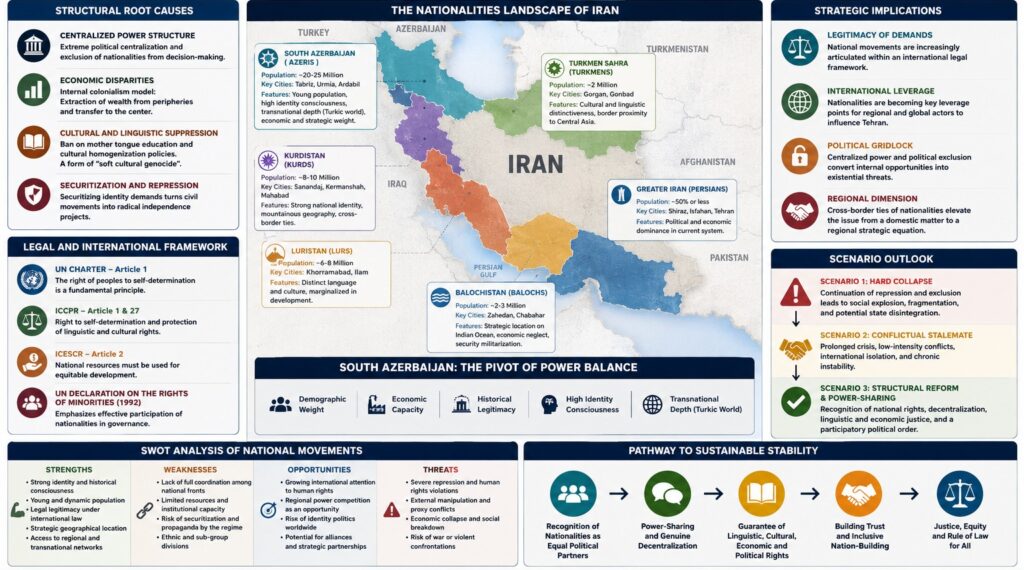
The nationalities question in Iran is no longer merely a cultural or identity-based issue. It has evolved into one of the central strategic variables shaping the political survival of the Islamic Republic and the future political order of the country. Any serious strategic assessment of Iran’s future must recognize that the widening gap between the center and the peripheries has simultaneously acquired legal, economic, security, and geopolitical dimensions.
Over the past four decades, the Islamic Republic has attempted to manage the nationalities issue through securitization, cultural control, and centralized governance. The outcome, however, has not been sustainable integration, but rather the accumulation of structural grievances. Today, a significant portion of political forces in non-Persian regions have moved beyond demands limited to cultural rights and entered a phase of political and governance-oriented mobilization. This transformation has fundamentally altered the nature of the crisis.
From the perspective of international law, the discourse surrounding nationalities is increasingly grounded in the principle of the “right to self-determination.” Article 1 of the United Nations Charter, as well as the International Covenant on Civil and Political Rights, recognizes the right of peoples to freely determine their political status. This legal framework has enabled political movements in regions such as South Azerbaijan, Ahwaz, بلوچستان, and Kurdistan to redefine their demands not merely in cultural terms, but within the broader framework of international legal and political legitimacy.
In contrast, the Iranian state continues to interpret these demands primarily through the lens of security threats and separatism. While this approach may generate short-term security control, it also contributes to the long-term radicalization of demands. Numerous ethnic and national conflicts worldwide demonstrate that political exclusion tends to weaken moderate actors while strengthening separatist and independence-oriented tendencies.
Economically, the widening divide between the center and peripheral regions has become another major component of the crisis. Many activists and intellectual circles in non-Persian regions characterize Iran’s development model as a form of “internal colonialism,” in which the natural resources and human capital of peripheral regions are utilized to consolidate power and wealth at the center. Khuzestan, despite its immense energy resources, بلوچستان despite its geostrategic location, and South Azerbaijan despite its industrial and commercial potential, continue to face underdevelopment and brain drain. This reality has intensified perceptions of structural discrimination.
The cultural and linguistic dimension of the issue has also deepened. The prohibition of formal education in mother tongues is viewed by many national rights activists not simply as an educational restriction, but as part of a broader project of identity homogenization. As a result, linguistic rights have become one of the principal drivers of political mobilization among non-Persian nationalities. In this context, language is no longer merely a means of communication, but a symbol of power, dignity, and collective survival.
Among all regions, South Azerbaijan occupies a unique position in Iran’s internal balance of power. Its demographic weight, economic significance, historical legacy, social mobilization capacity, and geopolitical connections with the Turkic world make it one of the most decisive variables in Iran’s future trajectory. Any fundamental transformation in Iran’s political structure that ignores the role of Tabriz and South Azerbaijan is unlikely to achieve long-term stability.
South Azerbaijan’s transnational connections with the Republic of Azerbaijan and Turkey have further elevated the geopolitical significance of the issue. Unlike previous decades, the nationalities question is no longer viewed solely as an internal Iranian matter. It has increasingly become part of broader regional strategic calculations. Regional and global powers are gradually recognizing these internal fractures as potential leverage points capable of influencing Tehran’s behavior.
Under these conditions, the Islamic Republic faces a strategic dilemma. The continuation of centralization and securitization policies is likely to intensify centrifugal dynamics and increase the risk of hard-crisis scenarios. Alternatively, a structural redefinition based on decentralization, power-sharing, recognition of linguistic rights, and meaningful participation of nationalities in governance could provide a less costly path toward political transition.
Time, however, is becoming an increasingly decisive factor. The trust deficit between the center and peripheral regions has reached a level at which symbolic reforms are no longer sufficient to contain the crisis. A new generation in non-Persian regions increasingly frames questions of identity and political rights not as negotiable privileges, but as inherent and non-negotiable rights.
Strategic assessments of Iran’s future suggest that the country has entered a phase of structural redefinition. If the political system fails to establish a balance between territorial integrity and national pluralism, the likelihood of more costly and destabilizing scenarios will increase. Conversely, any political project capable of redefining the rights of nationalities within a pluralistic and participatory framework will possess a greater chance of creating sustainable stability.
The nationalities question is no longer a secondary issue in Iranian politics. It has become one of the principal variables shaping the future of the state, national security, and the regional balance of power. Any domestic or international arrangement that ignores this reality is likely to face a crisis of legitimacy and effectiveness in the medium term. Whatever the outcomes of Iran’s current war with the US and Israel, and regardless of which government or administration comes to power, it will have to take this reality into account in order to survive and continue on its path.